

Judicial candidates turn AMLO symbols into campaign props
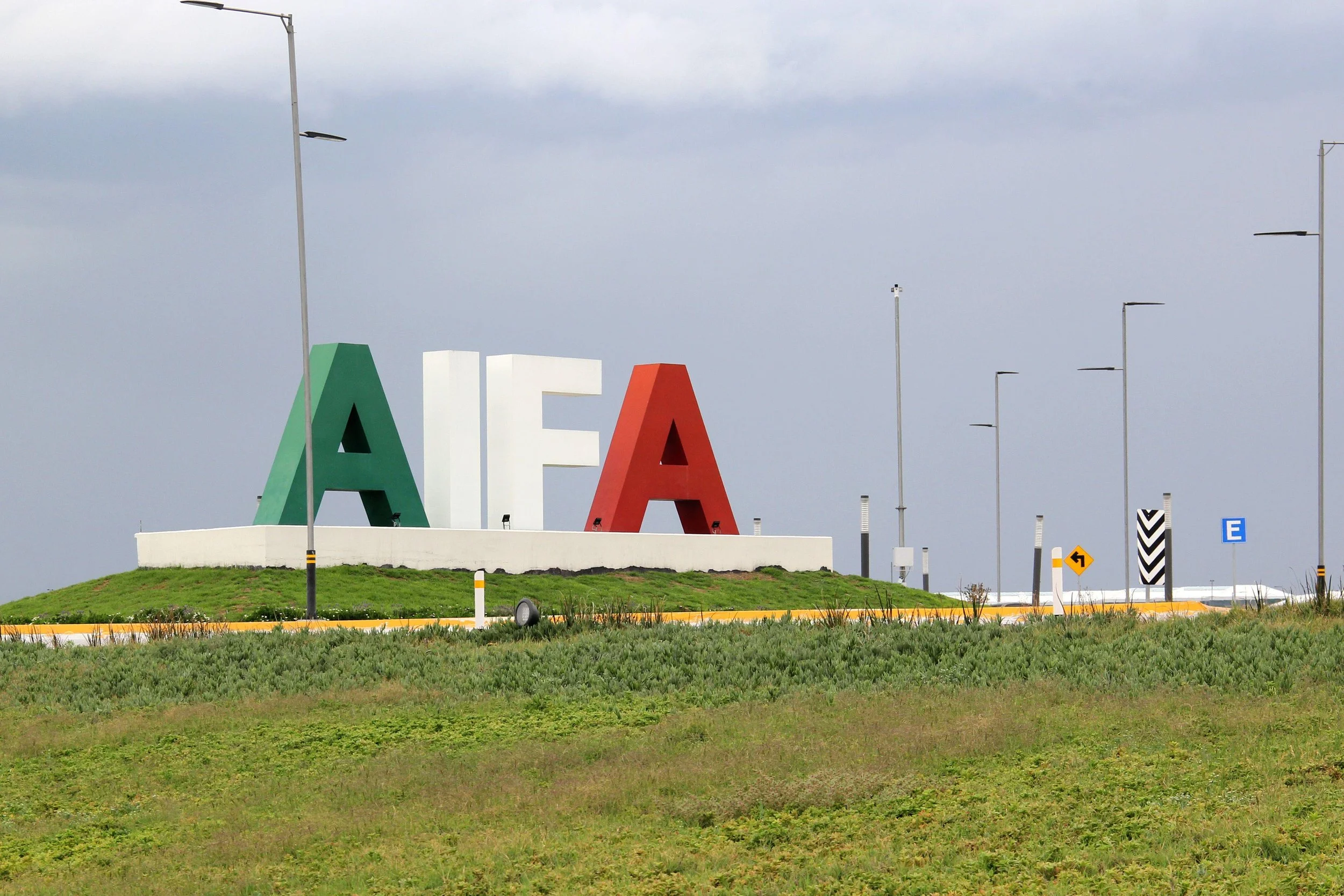
The exterior of Felipé Angeles International Airport (AIFA) outside of Mexico City. Image credit: Arlette Lopez / Alamy.
by David Agren.
César Gutiérrez Priego took a recent flight to Cancún in his campaign for a seat on Mexico’s Supreme Court. He made the trip a tour of the mega-projects built by Andrés Manuel López Obrador – the former president whose purge of the judiciary ushered in the judicial elections in the first place.
Gutíerrez, a criminal defence lawyer with a large social media following, made a point of flying from the Felipe Ángeles International Airport (AIFA) – the thinly-used facility in the boonies north of Mexico City championed AMLO and promoted heavily by 4T influencers.
He posted a customary photo from the landmark Piedra del Sol (Aztec calendar) replica in the cavernous AIFA terminal. He also made sure people knew he was taking Mexicana de Aviación, the military-run airline revived by AMLO, which cancelled more than half its routes earlier this year. Upon arriving in Cancún, he took a ride on the Tren Maya, the railway circling the Yucatán Peninsula.
“It doesn’t matter what the haters say: the Tren Maya is a transportation and public works jewel,” he said on X.
Mexico holds its first judicial elections June 1 with the country picking 881 magistrates, district judges and 11 supreme court justices. The elections are the first since the judicial overhaul was controversially approved by congress – with the ruling MORENA party notoriously using arrest warrants to turn an opposition senator and get the final vote needed.
AMLO often attacked for issuing injunctions against his prestige projects such as the AIFA and the Mayan Train. His supporters also took umbrage at court president Normal Piña – who AMLO didn’t support for that position – not standing for him at a public event.
Campaigns for the judicial elections kicked off on March 30 with more 3,400 candidates vying for legal positions – so many that ballots in many parts of Mexico will resemble roadmaps. Candidates face strict rules in campaigning. Candidates cannot buy campaign ads nor receive public money. Partisan support is prohibited, along with the use of religious and patriotic symbols.
Candidates have predictably become creative. Some have majored more in frivolity than seriousness to stand out in a crowded field – not unlike minor political party candidates, who capture attention through zaniness, but ultimately fall short.
One Supreme Court candidate christened herself, “Dora la Transformadora.” Another candidate for the high court called himself “ministro chicharrón,” (minister pork rind) whose TikTok video claim he’s “more prepared than a chicharrón” – while boasting he has a PhD, two master’s degrees and graduated from the UNAM.
The ham-fisted attempts at branding are to be expected in a crowded field, where many of candidates lack name recognition. Some like “Dora la Transformadora” are branding themselves with words affiliated with AMLO and the ruling party.
One of AMLO’s sons, José Ramón López Beltrán, recently posted his Supreme Court picks on X. Some were familiar names – such as the three Supreme Court justices, including Lenina Batres, who writes a newspaper column under the title, “ministra del pueblo” – that reliably backed his father’s agenda. Others announced their affiliations with AMLO through his movement’s buzzwords like “transformer,” “bienestar,” and “pueblo.”
The branding could prove especially important in a low-turnout election. A poll from El Financiero shows 43 per cent of Mexican are aware of the judicial elections, while 54 per cent were unaware of the vote. Just 12 per cent of respondents knew the election day was June 1.
A low turnout election could theoretically favour the ruling party with its motivated voters and organizational muscle (though the latter is ostensibly prohibited from being operated) It could also elect some controversial candidates to the bench.
Defensorxs, a public interest advocacy group, has launched a campaign to “impede that the judicial branch is captured by criminal interests or persons that present a risk to the imparting of justice.” Its work shows at least four candidates have links to La Luz del Mundo, the politically active Jalisco church – aligned of late with MORENA – whose leader, Naasón Joaquín García, was convicted in the United States on child abuse charges and charged with producing child pornography.
Silvia Rocío Delgado García formed part of Joaquín “El Chapo” Guzmán’s legal team and is now running as candidate for a state judicial position in Ciudad Juárez. The Chihuahua state governor’s office nominated her for the race.
Critics alleged from the start that AMLO’s judicial overhaul was an attempt by the president to take control of the judiciary. That’s part of why they’re being run as nonpartisan in the first place. But the early campaigning shows how candidates are aligning with his political movement, confirming the critics’ suspicions.