

Morena reacts furiously to UN probe into forced disappearances
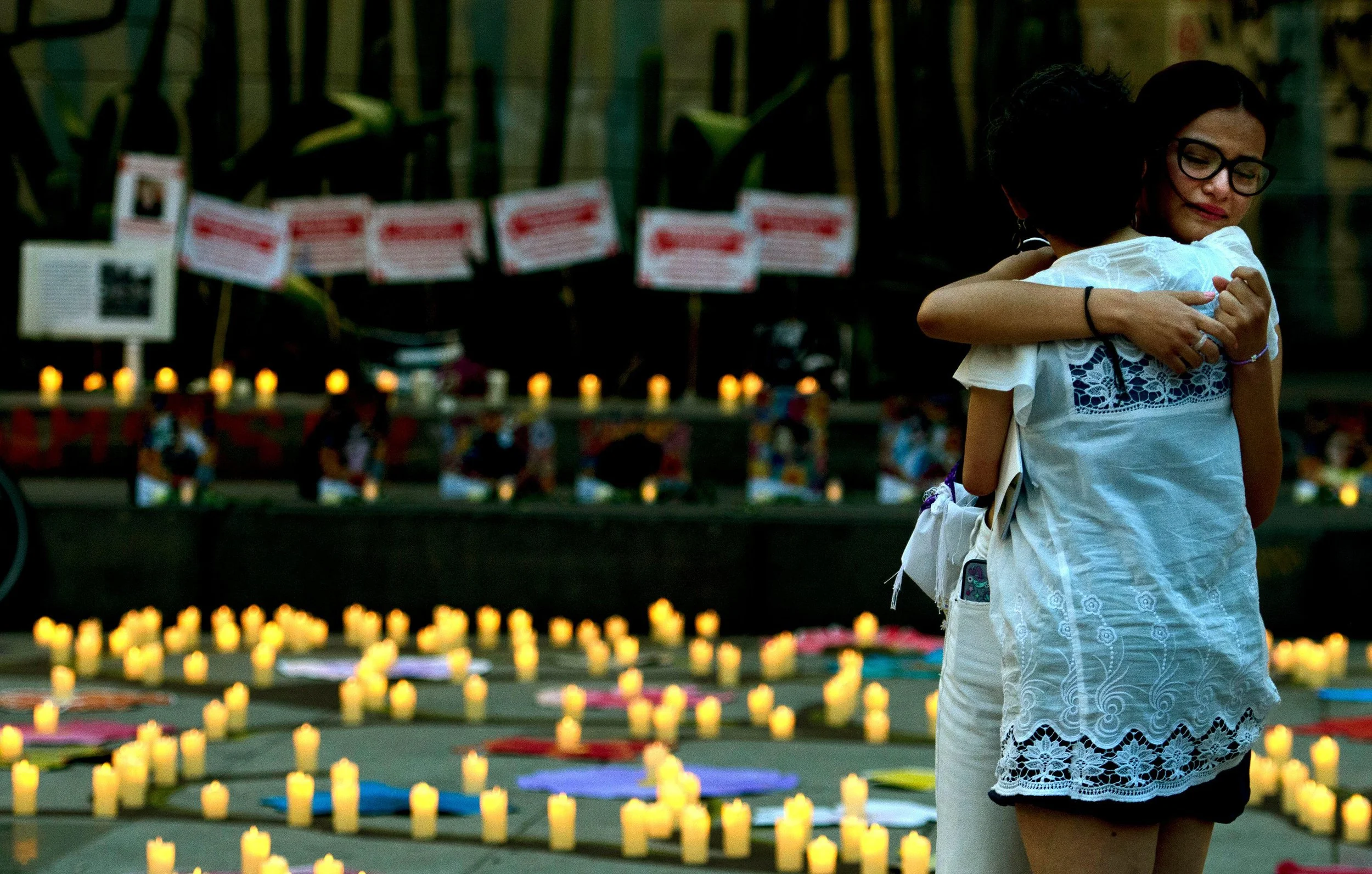
A family member of a victim of disappearance is embraced at a vigil for the country’s 120,000+ missing in 2024. Image credit: ZUMA Press, Inc / Alamy.
by Andrew Law.
“There is no forced disappearance in Mexico.”
That was the response from Mexico’s President, Claudia Sheinbaum, to news that the UN plans to investigate forced disappearances in the country. More than 124,000 people have disappeared in Mexico.
Sheinbaum’s claim was quickly supported by her Morena Party. Party members in the Senate passed a motion saying the government had no role in the crisis.
But last Friday, the UN Committee on Enforced Disappearances announced it would launch a formal investigation. Committee President Olivier de Frouville said the inquiry was based on three Articles of the International Convention for the Protection of All Persons. According to El Financiero, he made it clear that this “in no way prejudges the Mexican state.” Still, de Frouville added, “We have received information that… provides sufficient grounds to support the belief that enforced disappearances are practiced on a widespread or systemic basis.”
The UN’s careful language did not stop the backlash. Luisa Alcalde, party president of Morena, attacked the Committee on the social media platform X. She said - without providing proof - that the investigation was “politically motivated” and that the UN “doesn’t like progressive governments that are close to the people.” She also claimed that since Morena came to power in 2018, the government has not committed human rights abuses.
“This is highly questionable,” says Jacques Coste, a historian at Stony Brook University and expert in Mexico’s security. “Because in a lot of cases, as in Teuchitlán, the government participates by omission… by not doing anything to prevent the disappearances.”
Coste says the government also puts up barriers for families trying to find their missing loved ones. “They also,” he adds, “often work hand in hand with criminal groups to commit the enforced disappearances. A lot of family members… argue that their loved ones were disappeared by police forces, the army, or by criminal groups in collaboration with state authorities. So that technicality… is totally inaccurate and false.”
This matches recent reports about three missing film students in Jalisco.
Morena leaders also called for de Frouville to be removed. Gerardo Francisco Noroña, the Senate President, said the UN made “a baseless accusation” and challenged the Committee to show evidence that Sheinbaum ordered any disappearances. But the Committee had already made clear it was not accusing her personally.
Whether Sheinbaum ordered any disappearances is beside the point. No credible source is saying that. The concern is about institutions within Mexico.
Between 2019 and 2023, Mexico’s National Human Rights Commission received over 1,700 complaints about the National Guard. As reported by Latinus, these include allegations of torture, arbitrary detention, and even killings.
Another report from Proceso focuses on the Foundation for Justice and the Democratic Rule of Law (FJEDD). The group represents 235 families of missing migrants who disappeared while traveling through Mexico. Their report accuses officials of underreporting migrant disappearances. One case it highlights involves a Nicaraguan girl who disappeared in May 2022 near the Rio Grande. The case received wide media attention at the time.
The Morena Party has downplayed the issue since the time of President López Obrador (AMLO).
“At first,” Coste says, “Mexico under AMLO advanced in recognition in the size of the crisis. It took actions to build the infrastructure to start identifying bodies and search for the disappeared.” But that changed. AMLO shifted blame to former President Felipe Calderón and denied the scope of the problem. Sheinbaum has followed that same path.
For example, in the case of Teuchitlán, she focused on word choice - whether the Izaguirre Ranch was an “extermination” or “training” camp - instead of addressing the broader crisis.
Coste says this reaction to UN scrutiny is also new. In the 1990s and 2000s, Mexico’s governments accepted international attention on human rights, even if reluctantly. “The UN produced a robust report in 2012 on forced disappearances,” he says. The report didn’t fix things, but it helped citizens understand the true scale of the problem. There’s value in that.
Now, Coste warns, that openness is gone. “Without the monitoring responsibilities of these groups, and with the co-optation of independent watchdogs by Morena, Mexico faces more impunity and less transparency… That’s why it is so problematic that Morena has in practice abolished the policy of open doors to human rights scrutiny.”