

Morena’s voter disconnect laid bare in judicial vote
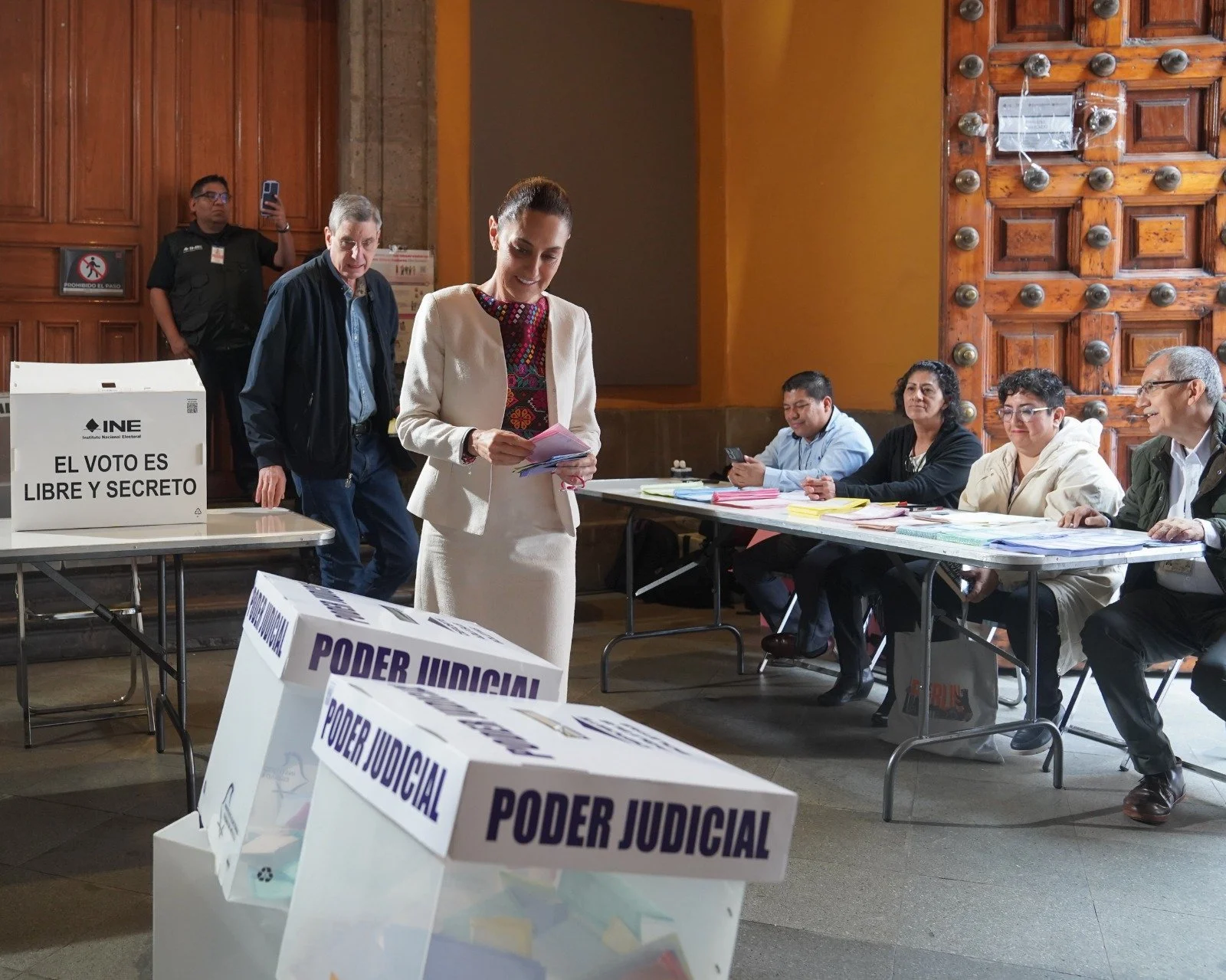
Mexico’s President Claudia Sheinbaum casting her vote in last Sunday’s judicial election. Image credit: Presidency of Mexico.
by David Agren.
Former president Andrés Manuel López Obrador appeared in public for the first time in eight months to cast his ballot in the recent judicial elections. The man known as AMLO voted using a cheat sheet, which listed the candidates endorsed by his Morena party.
“I wanted to participate in this historic election,” AMLO said afterward. “I’m very happy to live in a free and democratic country.”
AMLO along with his protégé and successor, President Claudia Sheinbaum – whom he lauded Sunday as “the best president in the world” – hailed the election of nearly 900 judges and magistrates as a democratic success.
The country’s hapless opposition branded the exercise a farce and boycotted the process. Many Mexicans, meanwhile, showed a crushing indifference and stayed home; just 13% of registered voters cast ballots, while 10% of those ballots were annulled.
The elections delivered the outcome that AMLO presumably wanted when he purged the courts with his so-called judicial reform and put all judges and magistrates, including supreme court justices, to popular vote.
The supreme court candidates on most of the cheat sheets distributed by Morena operatives won their races. Three of the justices: Yasmín Esquivel, Lenia Batres, Loretta Ortiz, were already on the bench – with the first two nominated by AMLO – while of the others had ties to the former president.
The reform also created an elected disciplinary tribunal, which will oversee the judicial branch. Celia Maya, twice Morena’s gubernatorial candidate in Querétaro, will preside over the tribunal. The president of a legal professional organization described the tribunal as a “tool of political control,” which will “pursue whatever judge it wants, including supreme court justices.”
“Mexico is the most democratic country in the world,” Sheinbaum said after the vote.
But the effective takeover of the judicial branch felt hollow for the ruling party, which aggrandized itself with a membership drive to make one of the world’s biggest political movements.
“It was a defeat for their narrative as a popular and democratic movement,” said Bárbara González, a political analyst in Monterrey.
Low participation showed that “contrary to what the ruling party publicly said, the judicial reform did not happen because people demanded it,” she explained. “The ruling party has a limited capacity to mobilize people, despite its disdain for the rules: hauling people to the polls, the cheat sheets, using government operations.”
The 13% turnout came amid an attempted turn-out-the vote operation – a common practice in Mexican politics across the party divide. Social media stories abounded of people lined up to vote with Morena-distributed cheat sheets. Voters over age 60 – many of whom are eligible for cash stipends and can be coerced by Morena operatives – turned out in larger numbers than the young.
Surprisingly, the largest turnout came in Coahuila, one of two states still governed by the Institutional Revolutionary Party (PRI), with 24.3%. Durango, the other PRI-ruled state, placed second in turnout with 19.6%turnout, followed by Morena-ruled Veracruz at 19.4%.
The judicial elections coincided with municipal elections in both Durango and Veracruz, where Morena underperformed its previous vote total – losing a pair of municipal governments in Durango and 24 municipalities in Veracruz – despite Sheinbaum’s high approval rating.
The low judicial election turnout and underwhelming results in Durango and Veracruz cast an unflattering spotlight on Andrés Manuel López Beltán, AMLO’s son and Morena’s operations chief. López Beltrán, commonly called, “Andy,” had previously kept a low-profile and showed little of the operations success of his father. He blamed paid-off media for “turning against me,” then told a Morena podcast that he wanted to be called “Andrés Manuel” rather than “Andy.” “Stop calling me by diminutives and names that are not my name.” he said.
With the underwhelming turnout, commentators sympathetic with Morena promoted a new narrative of change arriving in the court. With Hugo Aguilar Ortiz leading the vote count for the Supreme Court – making him the likely court president – some commentators highlighted his biography as an indigenous Mixtec lawyer originally from Oaxaca state.
Critics pointed out that he appeared on the Morena cheat sheets and his leading the Instituto Nacional de Pueblos Indígenas (INPI) since 2018 – being appointed by AMLO.
Former presidential candidate Xóchitl Gálvez, also a former indigenous institute director, said of the likely new court president, “Hugo Aguilar is a cordial, conciliatory, prudent man, and deeply knowledgeable about the rights of Indigenous peoples. Although as a public official, his loyalty to López Obrador outweighed his loyalty to Indigenous peoples.”
Lost in the controversy of the judicial election is the fact that Morena presidents (AMLO and Sheinbaum ,and possibly a third president from the party) would have reshaped the courts through the appointment process. But AMLO didn’t leave that to chance. Several of his picks didn’t follow his direction and voted against his projects – prompting his purging of the courts.
“They’re greedy. And AMLO is proud of his vengefulness. The judiciary objected to his power grabs, so it had to go,” González said. “The low turnout, who arrived to vote, and how they arrived there, proved the reform’s critics right: it was the capturing of the judiciary by a ruling party that does not believe in the separation of powers or democracy.”