

Mexico is paying a high price for its opposition parties’ malaise
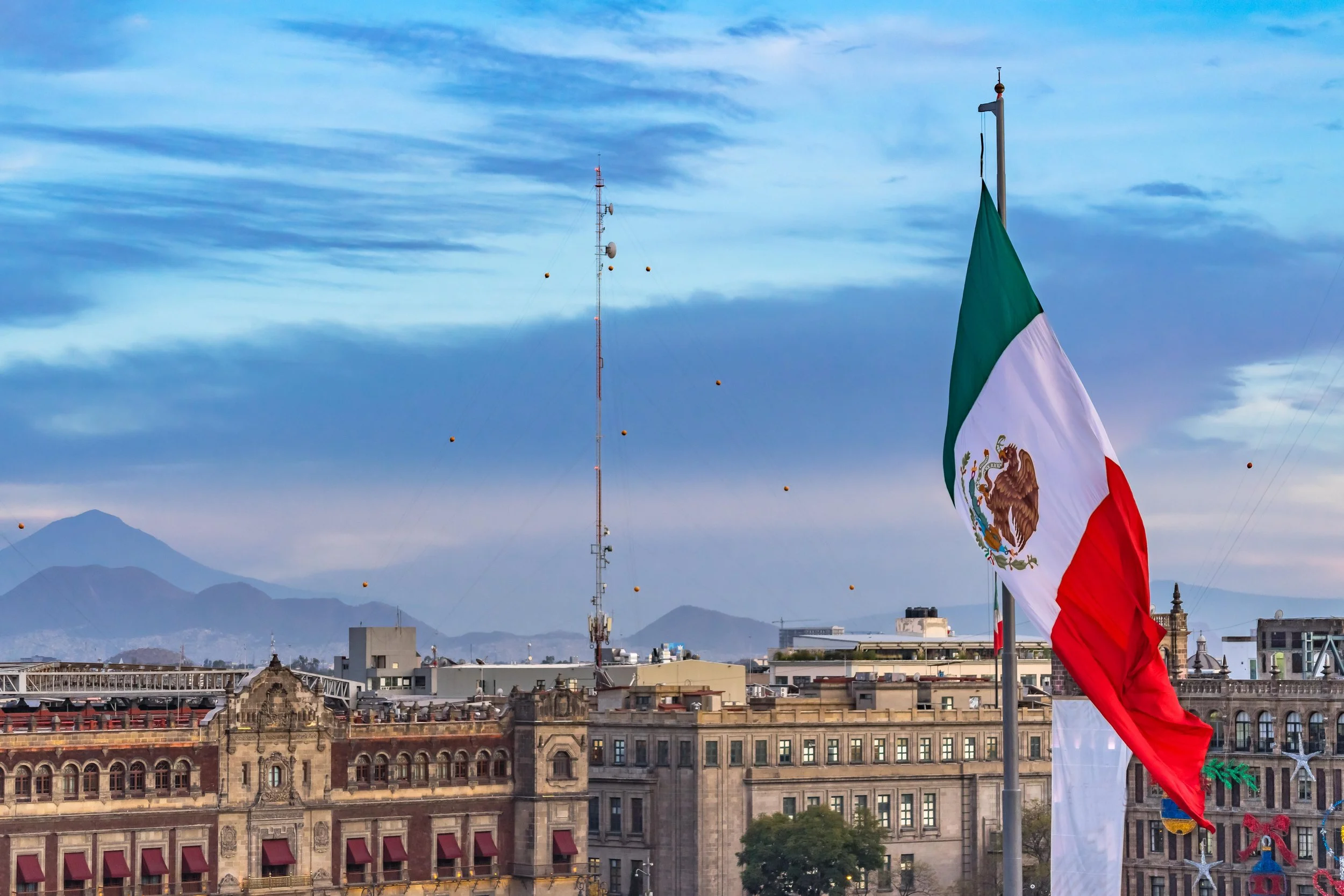
The Mexican flag flying over Mexico City’s Zocalo at dusk, with the National Palace in the background. Image credit: William Perry / Alamy.
by Gerónimo Gutíerrez.
Editor’s note: Amb. Gutíerrez served as Mexico’s Ambassador to the United States and also as Mexico’s Undersecretary for Governance.
— —
Mexico’s political opposition today finds itself in a dire position. Since its founding in 2014, the ruling Morena Party has made extraordinary gains. It now holds the presidency, 23 of 32 governorships, comfortable majorities in the federal congress and 27 state legislatures, and, together with its allied parties (the Workers' Party, or PT, and the Green Party, or PVEM), has the power to enact laws and even amend the Constitution at will. President Sheinbaum enjoys exceptionally high approval ratings (around 70%), much like her predecessor, former President Andrés Manuel López Obrador, did.
In recent years, Morena-led governments have taken actions that appear to significantly weaken institutional checks and balances, the separation of powers, and democratic norms. To be sure, Morena and the President reject this characterization — but critics, both in Mexico and abroad, make a persuasive case. For example, the Global Democracy Index published by The Economist now classifies Mexico as a hybrid regime, no longer even a flawed democracy.
In the 2024 election, the traditional parties (PAN, PRI, and PRD) received only 27% of the presidential vote, compared to the 60% won by Claudia Sheinbaum. Currently, the PAN governs just four states, the PRI only two, and both hold modest parliamentary groups in Congress. The PRD no longer exists. Movimiento Ciudadano (MC) appears to be the emerging party. It secured a significant 10% of the presidential vote in the last election and currently governs two states. However, it is hampered by internal inconsistencies and scandals, which raise serious doubts about its long-term potential.
Under these circumstances, it is only natural to ask whether the political opposition has pursued the right strategy to counter Morena’s rise — and if not, what that strategy could look like in the future. There are no easy answers, but perhaps a few sensible working hypotheses.
In a country where 43% of the 128 million population lives in poverty (according to 2022 official figures), machine politics work. The Morena governments have built a vast platform of social programs, including direct cash transfers that reach an estimated 25 million households. Opposition parties have wavered between timidly supporting these programs and criticizing their effectiveness, political bias, and fiscal sustainability. Unless they can clearly articulate where they stand — and what they would do better — the government and its party will likely continue to enjoy the support of a vast portion of the electorate.
The government by and large commands the public agenda through an attractive narrative, a mix of propaganda, the daily presidential press conference — now dubbed the mañanera del pueblo — and, some would argue, by suppressing freedom of speech. There is likely no quick or easy solution to this problem, but it’s fair to say that the opposition has lacked a successful and consistent communications strategy.
For years, the opposition’s primary message has been a blunt, gloves-off critique: that Morena and its presidents pose a danger to Mexico’s future. This may very well be true — but people simply aren’t buying it. Worse, this approach seems to fuel, rather than diffuse, the polarization and us-versus-them rhetoric that Morena has mastered.
Instead, the opposition would do well to focus more on what it can offer —something better than the status quo — rather than just on why the incumbent is worse. The PAN’s historic victories, including its first presidential win at the turn of the century, came when voters — who were well aware of the PRI regime’s shortcomings — saw a brighter future with PAN. Similarly, the PRI regained the presidency not by obstructing the PAN government (2000–2006), but by positioning itself as a constructive opposition that “knew how to do things better” (2006–2012).
A recent wave of studies highlights growing disenchantment with democracy worldwide—and Mexico is no exception. The latest Latinobarómetro poll (2023) indicates that only 35% of Mexicans prefer democracy over other forms of government, down from 43% in 2022. This figure places Mexico near the bottom among its Latin American peers. Even more striking, 33% of Mexicans say they believe an autocratic regime might be preferable to a democratic one. A 2018 Pew Research Center poll found that an alarming 85% of Mexicans were dissatisfied with democracy — the same year Morena came to power. There is ample reason to be concerned about the trajectory of Mexico’s democracy, and the burden of proof to dispel these concerns rests squarely with President Sheinbaum and her party. The challenge for those raising the alarm — including Mexico’s political opposition — is that too few Mexicans are paying attention, or seem to care.
Mr. López Obrador had his fair share of scandals and policy failures — many of which President Sheinbaum must now manage, and ideally not worsen. He launched an overhaul of the health sector which, according to the government’s own 2022 data, left 39% of the population without adequate access to health services.
The former president also championed several major infrastructure projects that demanded substantial public resources, ran significantly over budget, and are now incurring financial losses. Among the most notable are a US$21 billion refinery that is not fully operational and the much-publicized Mayan Train, which has so far cost around US$25 billion and serves less than 5% of its projected ridership.
Meanwhile, the economy has remained sluggish, with real GDP per capita growth under Morena essentially flat.
Despite all this, both AMLO and Sheinbaum seem to enjoy a kind of “Teflon coating” that allows them to remain popular — and Morena to keep winning.
Notwithstanding its own shortcomings, the opposition faces a very tough short-and-medium-term scenario. It might turn out that their only strategy is to “wait it out” and let reality check the narrative. The cost for Mexico, however, could end up being extraordinarily high.