

Mexico’s new security laws expand military power and erode civilian oversight
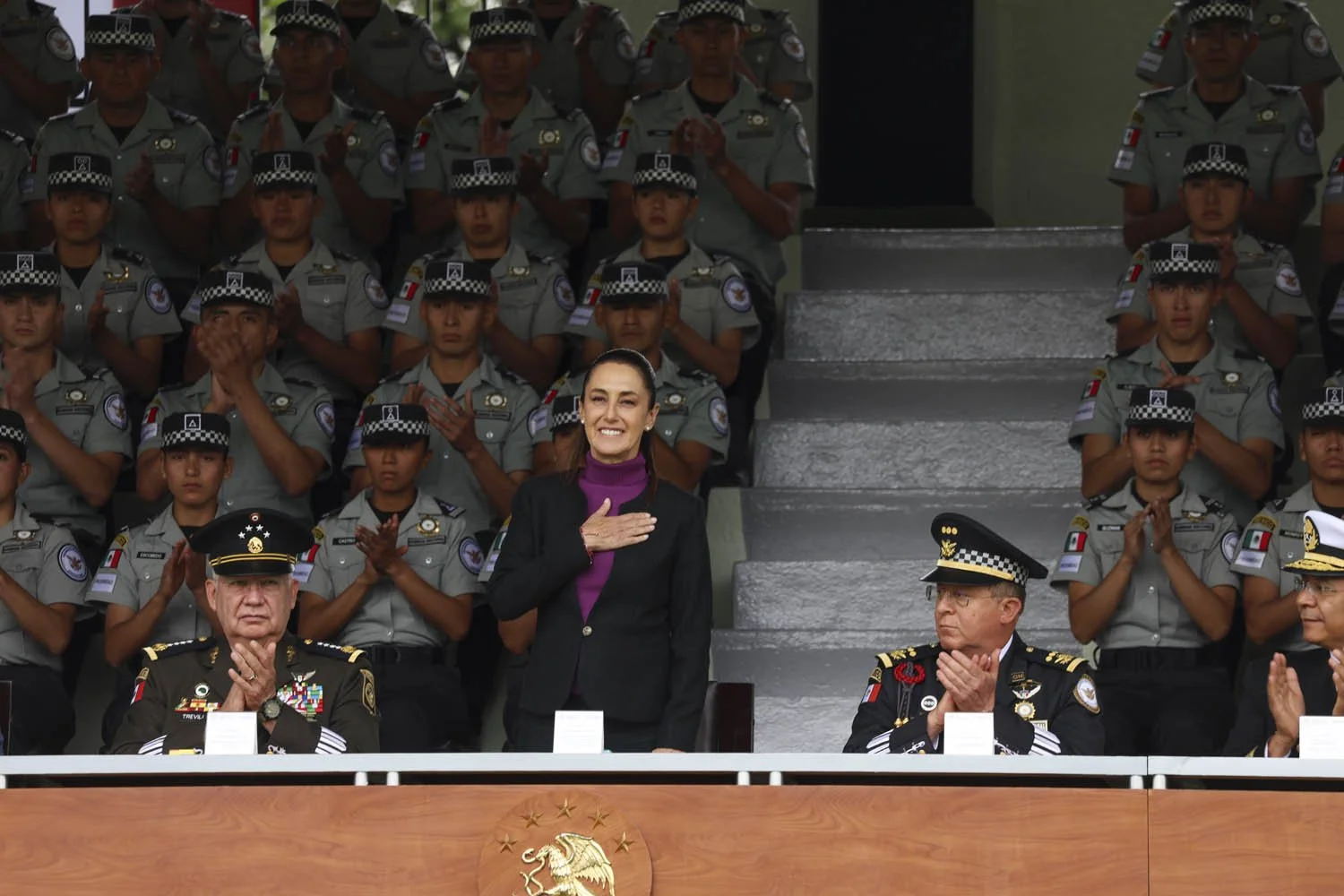
President Claudia Sheinbaum addressing Mexico’s National Guard on its sixth anniversary in Mexico City this week. Image credit: Presidency of Mexico.
by Emiliano Polo.
Editor’s note: Mr. Polo is a Mexican lawyer and political analyst who is an expert in international and constitutional law.
— —
The final stage of the National Guard’s militarization is now underway. In September 2024, former President López Obrador amended the Constitution to formally place the National Guard — already operating in practice as a military force — under the control of the Ministry of Defense. Last week, Congress convened an extraordinary session to approve legal reforms introduced by President Claudia Sheinbaum. These reforms aim to align at least nine existing laws with the 2024 constitutional amendment and complete the transformation of the National Guard into the fourth branch of the armed forces. These secondary laws mark the culmination of the process initiated by López Obrador and underscore that Morena’s priorities remain unchanged.
Throughout its electoral victories, Morena has made clear its conviction that the military should play a prevalent role in public life. The secondary legislation has further entrenched this vision, and the concern lies not merely in the specific laws being passed, but in the broader ambition to forge a new political regime defined by the primacy of military authority. In liberal democracies, the military sphere is deliberately constrained; in illiberal regimes, it is expanded.
Before the 2024 reform, the Constitution stated that in times of peace, the military could not perform any activities other than those strictly related to military discipline. The constitutional reform changed this, allowing the armed forces to carry out any function established by secondary law. This is a significant shift which opens up many new possibilities for what the armed forces are allowed to do.
For example, the amendments submitted to the legislature expand the powers of this body, authorizing it, among other things, to intercept private communications and carry out undercover operations. This move comes alongside the recent elimination of the autonomous institute that guaranteed access to public information (INAI), further weakening civilian oversight and transparency. Taken together, this contradicts the principles of public and civilian security, which reserve criminal investigations for civilian authorities. The tendency present throughout these reforms is to grant more attributions to the army, gradually expanding its role until its presence in public life becomes the norm, and its exclusion the exception. The changes related to the National Guard, in line with the previous administration’s reforms, eliminate any civilian character from the institution, formally establishing it as Mexico’s fourth armed force. The National Guard as an armed force displaces a model of civilians investigating civilians to one where soldiers investigate civilians.
The secondary legislation also represents a distortion of the concept of public security. A new General Law on the National Public Security System is being proposed to provide coherence and coordination among the three levels of government in security matters. While it designates the Ministry of Public Security as the coordinating authority, it assigns those responsibilities to the ministry without equipping it with the necessary capacities. This contradiction is evident in the transfer of the National Guard to the armed forces, which aligns its structure — ranks, hierarchy, and command — with that of the Army rather than the civilian institution.
All of this is unfolding within a broader shift away from the concept of public security toward the more ambiguous and loosely defined notion of national security. The new National Security Law allows the Ministry of Defense to generate, operate, and use its own intelligence under the vague and expansive parameters of national security. This framework is frequently applied with excessive flexibility to justify legal exceptions—for example, withholding information on the grounds that its disclosure could compromise national security.
The new legislation also expands military privileges in other areas — for instance, by granting special licenses for active members of the National Guard to participate in electoral processes, a provision already available to military personnel. These changes are accompanied by a so-called judicial reform that effectively gives the ruling party control over the judiciary, as well as the extension of military jurisdiction to members of the National Guard starting in 2024. Beyond the legal framework, however, the majority of personnel, funding, and operational capacity remains concentrated in the hands of the military. In short, there is a clear mismatch between the legal authority of a civilian ministry and the material dominance of the armed forces.
The secondary legislation is yet another sign of the advance of a new political-military order, one that began under the López Obrador administration and is now being consolidated under the government of Claudia Sheinbaum. The military will increasingly seek greater powers, and the ruling party’s constant willingness not only to grant them, but to actively promote this ambition, has already reshaped Mexico’s political system.