

As new Ambassador arrives, what next for the US & Mexico?
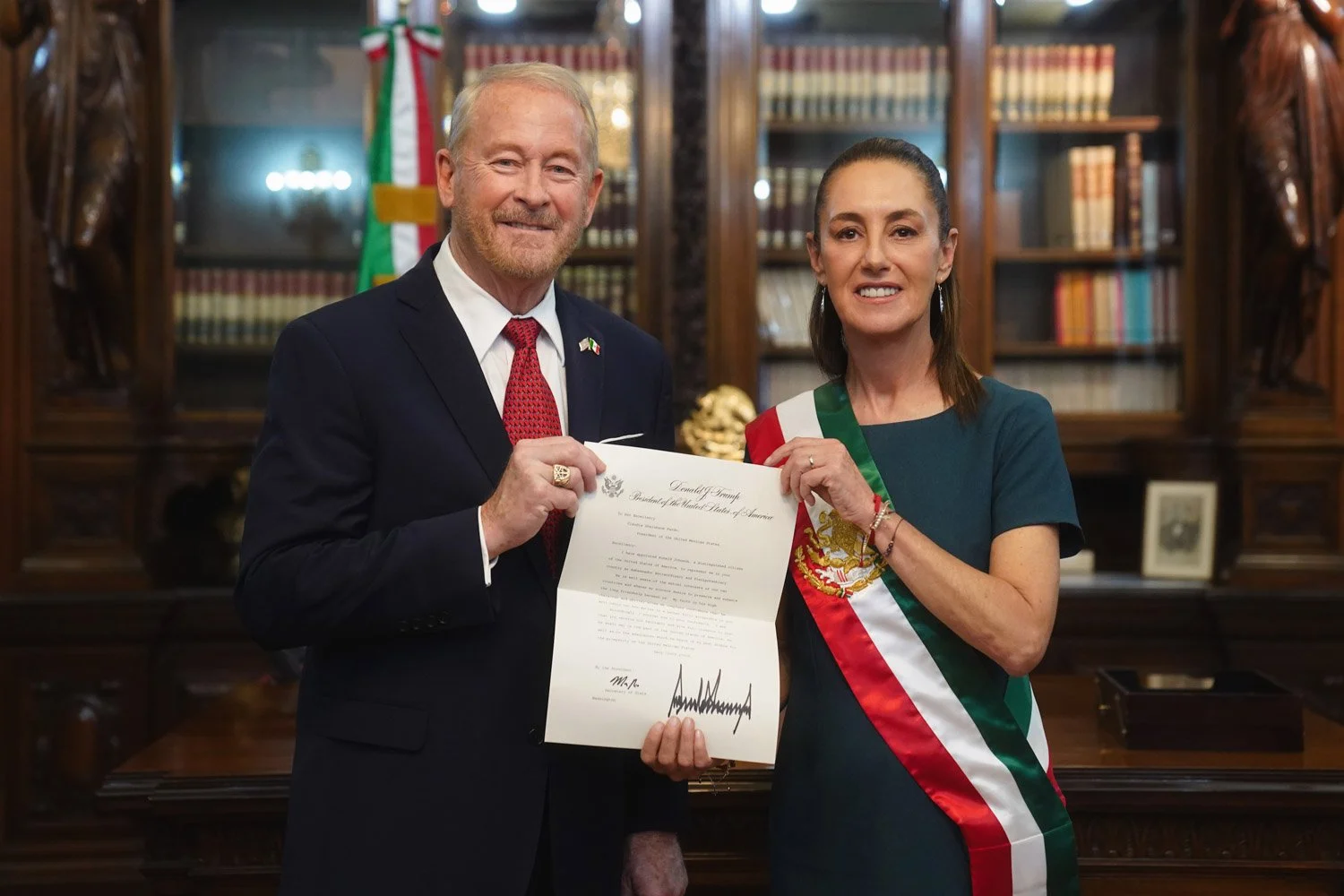
New US Ambassador to Mexico Ron Johnson with Mexico’s President Claudia Sheinbaum. Image credit: Mexican Presidency.
by Gerónimo Gutiérrez.
Six months after President Claudia Sheinbaum's initial call with then President-elect Donald Trump, the state of US - Mexico relations remains something of a puzzle. On the surface, early exchanges between the two leaders suggested a cordial start: Trump publicly referred to Sheinbaum as an "intelligent lady he could do business with," while Sheinbaum described their conversations as "productive" and appreciated what she called his "respect for Mexico." Yet this initial goodwill has given way to a more confrontational tone in recent weeks, reflecting growing difficulties beneath the diplomatic pleasantries that challenge the foundation of Sheinbaum’s strategy.
In the early days of May, Sheinbaum confirmed that she had rejected her counterpart´s offer to use US troops to go after cartels in Mexican territory. Trump in turn opined that she was “so afraid of the cartels she can’t walk”. More recently, news reports in Mexico and the US have suggested that the US government intends to cancel the visas and seize the US assets of Mexican politicians from the President’s party, allegedly due to links with drug trade and corruption. Raising the profile of these reports, the Governor of Baja California in the past days confirmed her visa was canceled, although she has alleged no wrongdoing and official information remains scant.
What was already a complex negotiation at the beginning of the year on trade (tariffs and USMCA review), security and immigration, has become more difficult with new irritants. As examples we can point to the case of water management of the shared river basins of the Colorado en Bravo rivers, or the decision by the United States Department of Agriculture to suspend all imports of live cattle due to phytosanitary concerns. In all areas of the relationship tensions seem to be mounting rather than receding. Perhaps the only exception is immigration, where migrant encounters along the border – a proxy used to measure illegal immigration – have drastically diminished in April to 12,035, from 179,737 the same month last year.
The current dynamic of the bilateral relationship behooves to ask what is really going on and if Sheinbaum’s approach with Trump is working. There are no easy answers to these questions, but the first point I would make is that, for Mexico, the recipe for a successful negotiation with the US has varied across time and context. Moreover, for quite some time now, heads of state, analysts, and people in general have thought and speculated about the best ways to deal with Trump. His first administration can serve as a reference point but not as a manual. President Trump has come in this second round with essentially the same ideology, but less internal counterbalances. He also has a better understanding of the in-and-outs of public administration and foreign policy. His blitzkrieg of the first few months on so many policy domains – including over 120 executive orders – tends to support this idea. It is plausible that for Mexico, as perhaps for other countries, dealing with Trump 2.0 is just more difficult that with 1.0.
Ronald Regan’s personnel director, Scott Faulkner, is credited for saying that “personnel is policy”. This might prove to be especially important in present US – Mexico relations. In contrast with Trump’s first administration, when Special Advisor to the President Jared Kushner had prominent and constructive role in working on relationship, currently no one seems to play that role within the White House on in the President’s inner circle. In addition, no NSC Director for Western Hemisphere has been appointed – a position which normally manages day-to-day operations with Mexico. A similar situation takes place at the State Department where no Assistant Secretary for the Wester Hemisphere has been appointed, and where Secretary Marco Rubio and Deputy Secretary Chris Landau – who has previous Mexico experience – have big portfolios. In short, Mexico faces a difficult counterpart structure irrespective of what the US administration’s position on Mexico might actually be. This is why the recent arrival of Trump’s new Ambassador, Ron Johnson, might turn out to be critically important.
This last point raises another relevant question which has concern all three Mexican presidents who have dealt with Trump: when and how should they meet with Trump? A meeting might very well represent a high-risk and high-return decision for Sheinbaum. But telephone calls – even the good ones – are no substitute for face-to-face discussion. President Trump is prone to leader-to-leader dialogues if he is looking for a deal, and if he perceives his counterpart is strong internationally or at least domestically. The decision is not an easy one, yet a meeting can prove the right action, especially as the current status quo does not look too promising with stalemate or erosion being the likely scenarios.
Critics of Sheinbaum’s approach argue – not without reason – that Mexico has increased cooperation on security and migration, avoid retaliating on tariffs, and show willingness to address the US’ China concerns, with no discernible positive results, as others have suggested in these pages. They point that Sheinbaum has just maneuvered with Trump if not accommodated, and that she has not confronted him. To be fair this is an issue with which all Mexican presidents have had to deal with given the marked asymmetry in the relationship. Yet, if there is one likely problem with Sheinbaum’s approach is that it has been piecemeal, meaning consisting of unsystematic partial measures taken over a period of time, which has just been pocketed by Trump who intends to go for more. Packaging a comprehensive and balanced deal might be as important as its contents.
At a more strategic level, regrettably, it can be argued that Trump simply does believe in the geopolitical value of a trilateral North America - or, for that matter, Mexico - and/or that Sheinbaum has not been able to persuade him such value exists. For Trump 1.0, it seems, USMCA was more about ending NAFTA that improving a construct – thirty-five years in the making – which is more relevant now in the face world supply chains reconfiguration and multipolar competition. President Trump’s approach to Canada, albeit being better with Carney that with Trudeau, lends itself in support of this notion. The recent call between the Canadian Prime Minister and the Mexican President is long due and a welcomed development. In their relationship with their common neighbor, Canada and Mexico face what game theorist describe as a “prisoners dilemma.” That is to say they can obtain certain benefits of working independently of each other (and for that incentives clearly exist), but they may do even better by working together and coordinating.
If the idea of North America as an integrated economic block and geopolitical handhold is to survive, much of the burden in the near future will likely fall on Canadian and Mexican trade and foreign policies.
Editor’s note: the author has served as Mexico’s Ambassador to the United States, Undersecretary for North America, and Deputy Secretary for Governance and Homeland Security.