

There’s a lot more driving Mexico City’s gentrification than bad gringos
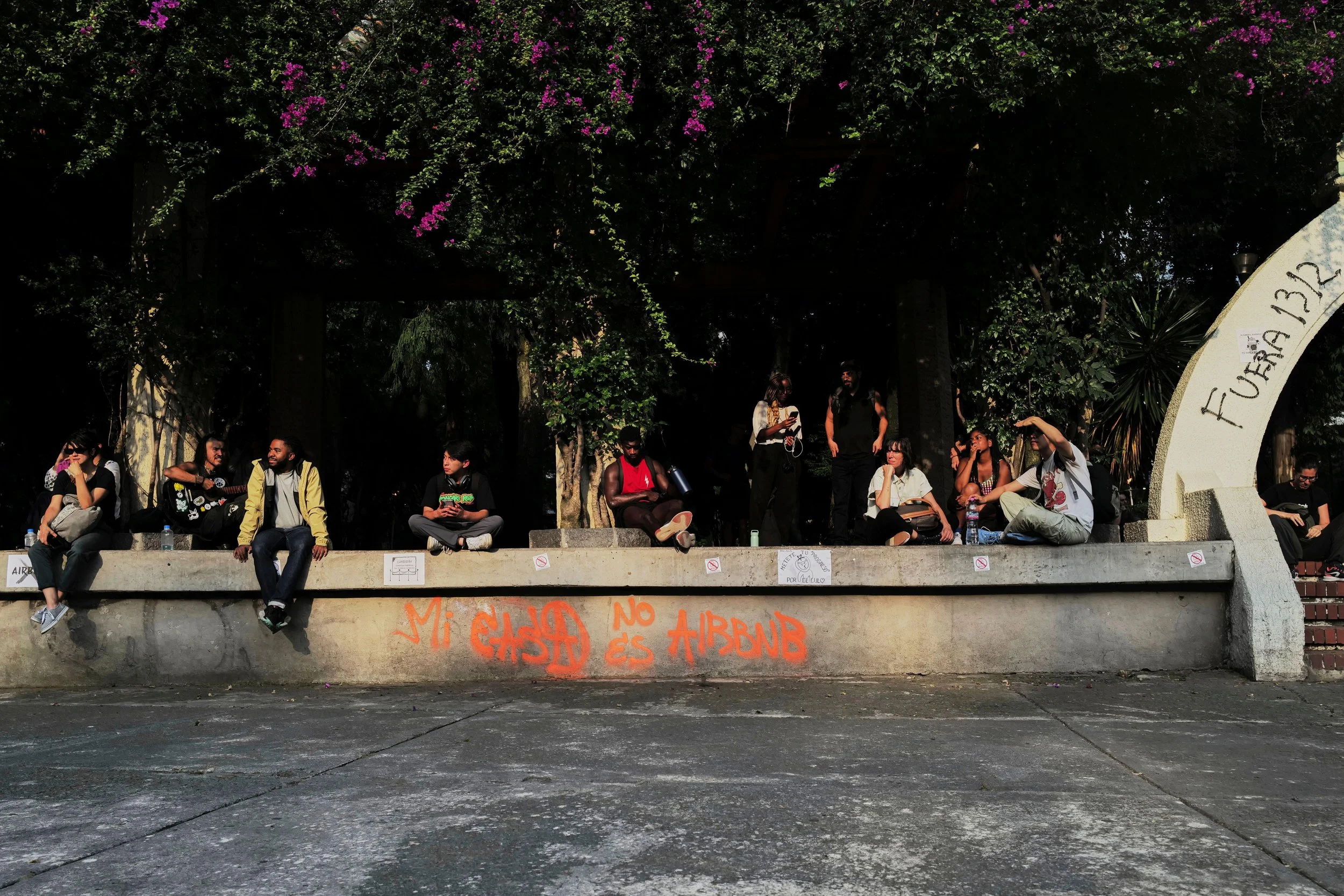
People sit on a wall in Condesa’s Parque Mexico on the sidelines of July 4th’s anti-gentrification protest. Image credit: Jon Orbach / AP / Alamy.
by David Agren, writer-at-large.
—
The acerbic signs and graffiti criticizing gentrification in Mexico City’s fashionable neighbourhoods were certain to capture international attention.
“Spanish is spoken here,” “Mexico for Mexicans,” and, “Go home,” read three of the screeds.
Social media couldn’t get enough of the disorderly protests – with the familiar masked vandals infiltrating yet another march and smashing up storefronts. The Mexico City police were curiously absent. An easy narrative of Americans abroad wearing out their welcome, while ICE cruelly rounded up Mexican migrants in cities such as Los Angeles.
The Department of Homeland Security jumped in with its own snark, posting, “Oh,” above an X Post with protester graffitiing the words, “Not your home,” and a protester waving a sign in English admonishing, “Pay taxes, learn Spanish, respect my culture.
Much of the international media, meanwhile, focused on the core matter of gentrification, which has spread through leafy neighbourhoods such as Roma, Condesa and Juárez – among others – over the past 15 years, driving up rents and forcing some long-term residents to move as their homes became short-term rentals.
The easy hook for any story on gentrification are the foreigners crowding Roma and Condesa. Some are digital nomads, but their numbers are unknown – with the figure of 1.6 million Americans living in Mexico somewhat imprecise because many them were born in the US to Mexican parents.
But digital nomads descended on Mexico City during the pandemic as Mexico’s coronavirus czar Hugo López-Gatell refused to close the border or demand vaccine requirements. Vaccine skeptics portrayed the city as perfect – with one prominent opponent of US pandemic policies claiming Mexico City lacked homelessness and crime, and claiming it even “smells great.”
Influencers arrived, too, publishing countless Instagram reels on vintage shopping, trying the (overrated) Taquería Orinoco or waiting in an endless line for the rol de guayaba at Panadería Rosetta.
But the recency bias misses many milestones on the path to gentrification – such as Argentines fleeing their country’s 2001 economic crisis being among the first foreigners to populate Condesa in meaningful numbers. The recency bias also overlooks the main progenitors of gentrification: rich Mexicans – including the country’s richest man, Carlos Slim Helú.
Slim invested heavily in the then-dilapidated Centro Historico in the early 2000s – at the invitation of the then-mayor AMLO – and remains a major property owner. He later gentrified the neighbourhoods adjacent to Polanco, creating the soulless Nuevo Polanco – where he built offices for his mobile phone empire and the Museo Soumaya.
Around the same time, wealthy Mexicans began purchasing properties in places like Condesa, Roma and San Miguel Chapultepec – with their children often living there.
Tourism also began booming in Mexico City. Visitors previously would arrive in the capital, sleep off their jetlag, then set off for points south. They would pass through the capital again prior to flying home. Nowadays, Mexico City is a destination itself, drawing the kind of visitors – often creatives – more interested in getting a table at a top-rated restaurant or taking a taco tour than staying at a resort in Cancún.
The kind of visitors attracted to Mexico City felt at home as remote workers. The amenities of Mexico City – where phones once took months to get connected and Telmex (allegedly) screwed with Vonage calls – made it easy: Costco delivered groceries, high-speed internet was widely available and the fashionable areas had a visible police presence.
Foreigners had no reason to worry about ugly politics – with a few publicly assailing this writer for stories on political matters they considered unflattering – or security as they didn’t receive calls (real or apocryphal) demanding ransom payments for kidnapped relatives.
As Mexico City’s mayor, President Sheinbaum embraced digital nomads – even forging an agreement with UNESCO and Airbnb to promote the capital as a remote working hub.
“Our goal is to keep digital nomads coming to Mexico City,” she said in 2022. “This tourism generates much greater economic benefits and also generates a cultural process that at the same time generates economic support for people.”
The President continued her open posture after the protest, saying, “Mexico is a country open to the world and non-discriminatory. Therefore, xenophobic attitudes cannot be justified.”
Other politicians from the ruling Morena party reacted predictably to the protests.
“Mexico City does not agree with gentrification. We reject this phenomenon that excludes the population from its neighborhoods and communities,” Mayor Clara Brugada said in a rather late statement after the protests.
Morena’s party president Luisa Alcalde blamed the usual suspects: the opposition. She noted that gentrification mostly occurred in three of Mexico City’s 16 boroughs: Benito Juárez, Cuauhtémoc and Miguel Hidalgo. Those boroughs have been ruled by the opposition at times – spare Benito Juárez, which has only had National Action Party governments since elections were first held in 2000 – while ignoring that parties aligned with AMLO have dominated local politics for the past three decades.
Mexican media subsequently revived stories of Alcalde and her sister, Mexico City prosecutor Bertha Alcalde, purchasing a home in the Roma neighbourhood in 2016 and developing an apartment building.
“The problem with the discussion about what's happening in Mexico City is that Sheinbaum’s people want to pretend they’re not involved in whatever they’ve done. They’ve controlled the city and its laws,” Rodolfo Soriano-Núñez, a sociologist, said in a WhatsApp chat. “I don’t deny how bad the PAN juniors who control Benito Juárez are. But they've never had the ability to issue a citywide decree or a law or anything like that. Whatever they do or have done, they do so within the framework defined by PRD-Morena governments, [who] never take responsibility for anything.”
Ultimately, observers pointed to a more straightforward problem in Mexico City, which the presence of foreigners perhaps exacerbates, but wouldn’t be resolved by their absence: little housing is being built in the capital.
“The problem goes beyond Roma and Condesa, which have always been relatively expensive areas, and affects the city as a whole,” Jorge Andrés Castañeda, a consultant, wrote in El Economista. “Mexico City requires around 60,000 new units annually to meet demand, but in 2023 only 3,500 homes were registered according to sector figures and official reports.”
The protest against gentrification generated attention. Hopefully it will also generate debate and better housing policies.