

Sheinbaum sticks to winning playbook in response to Trump’s FTO designation
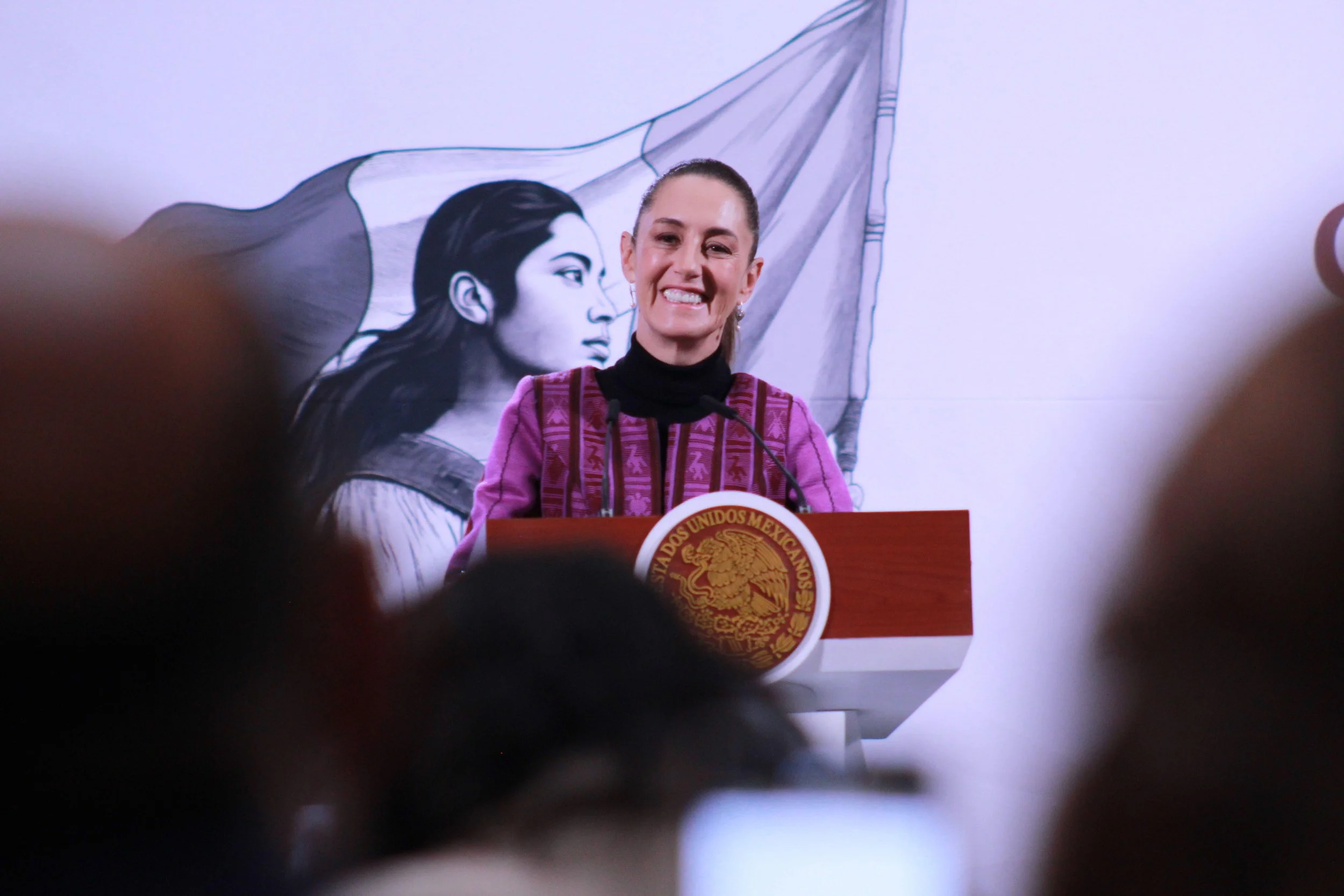
President Claudia Sheinbaum at a press conference in Mexico City this week. Image credit: ZUMA Press / Alamy.
by David Agren.
President Claudia Sheinbaum returned to a frequent topic of attention this week: the Gulf of Mexico – rechristened Gulf of America earlier this month by US President Donald Trump. Sheinbaum targeted Google, saying Mexico would sue the tech giant if its maps continued reading “Gulf of America” for the body of water hugging Mexico’s gulf coast.
“It’s a matter of sovereignty and recognition of our country against a private company, even if it is a private platform, there are international standards for how it is named,” she said at her Wednesday press conference.
The response to Google continued Sheinbaum’s communications pattern in responding to Trump’s actions: deploying the sovereignty discourse, avoiding direct criticism of Trump and blaming someone or something other than the US president. She always ends with a sober call for dialogue and an offer of cooperation.
Sheinbaum responded in a similar fashion to Google with a graver issue for Mexico: The US designating six drug cartels as foreign terror organizations (FTOs).
“The people of Mexico, under no circumstances will accept interventions, interference or any other act from abroad that is harmful to the integrity, independence and sovereignty of the nation,” Sheinbaum said Thursday, striking a familiar rhetorical flourish of nationalism.
She proposed a pair of constitutional amendments in response to the FTO designation. One of the amendments bans the foreign agents from carrying out investigations or pursuing suspects without Mexican permission. The other proposes tougher penalties and pre-trial (preventive) detention for anyone involved in weapons trafficking.
“We don’t negotiate sovereignty. As I said, this cannot be an opportunity for the United States to invade our sovereignty, so they can call it whatever they want, but with Mexico, it’s collaboration and coordination, never subordination, not interference and much less invasion,” she said.
Sheinbaum’s communications have drawn acclaim and even held up as an example for dealing with Trump. Her maxim of keeping a “cool head,” while indulging moments of levity – such as her initial response to the Gulf of America, when she showcased an old map demarcating Mexican America for territory now part of the United States. She defused Trump’s planned tariffs after a lengthy conservation with the US president and, unlike Canada, held off on announcing retaliatory measures.
“Trump liked her toughness, but at the same time she played ball,” The Wall Street Journal cited sources saying. “Troop deployment is something that Trump loves,” one Mexican official said.
She’s kept her criticism focused on the US society – she repeats her predecessor AMLO’s comments on fentanyl, asking why the US doesn’t care for its youth as Mexico supposedly does – or the US’s own issues with drugs and crime.
She raises the gun issue, too, pointing out how smuggled US weapons arm drug cartels and cause chaos in Mexico. “If there’s a place that such an [intolerable] alliance exists it’s with US gunmakers, which sell high-power weapons to these criminal groups,” Sheinbaum said after Trump announced tariffs, only to postpone them by a month. This week, she announced Mexico would expand its lawsuit against US gunmakers. Her supporters, meanwhile, questioned why US gunmakers wouldn’t be impacted by the FTO designation given how many weapons flow into Mexico.
Along with avoiding tariffs, Sheinbaum has most vociferously objected to the FTO designation.
Mexican governments have long opposed the FTO designation. Analysts say it complicates doing business. Companies often pay extortion in areas controlled by drug cartels, meaning such payments, “even if made under duress, could be considered ‘material support’ to terrorist organizations,” according to a factsheet from FTI consulting. It also raises fears of US forces taking unilateral action in Mexico against drug cartel targets.
But it reflects US perceptions of inaction on crime during the AMLO administration with his stated security policy of “hugs, not bullets.”
“There’s a perception, not far from reality [that] the Mexican government has been very passive, very complacent and very reluctant to take risks and confront organized crime,” security analyst Eduardo Guerrero said on a recent podcast with host Enrique de la Madrid.
Sheinbaum appears to have quietly abandoned “hugs, not bullets.” The federal government has returned to providing details on dismantling drug labs and providing arrest numbers. American troops also received permission to enter Mexico to train Navy marines.
The dogged defence of Mexico’s sovereignty also seems to have its limits. CNN and The New York Times reported this week that drones have flown over Mexico, spying on drug cartels. Other spy aircraft have also flown missions near Mexican territory, such as an Air Force RC-135 over the Sea of Cortez – off the coast of Sinaloa.
Sheinbaum downplayed the drone flights, saying there was nothing illegal and described it as being in coordination with the US. She turned conspiratorial, however, taking a page from her predecessor and questioning why the Times was reporting on that matter. “It’s because they want to undermine us, as if we were negotiating national sovereignty,” she claimed.
The president’s discourse is skillfully rallying the Mexican population and animating Trump’s opponents – without antagonizing Trump. She also comes across as the adult in the room. But it betrays the difficult hand she’s been dealt: Sheinbaum quietly agrees with Trump’s demands, while using the morning press conference to successfully save face.