

Mexico sinks in corruption index while Sheinbaum floats
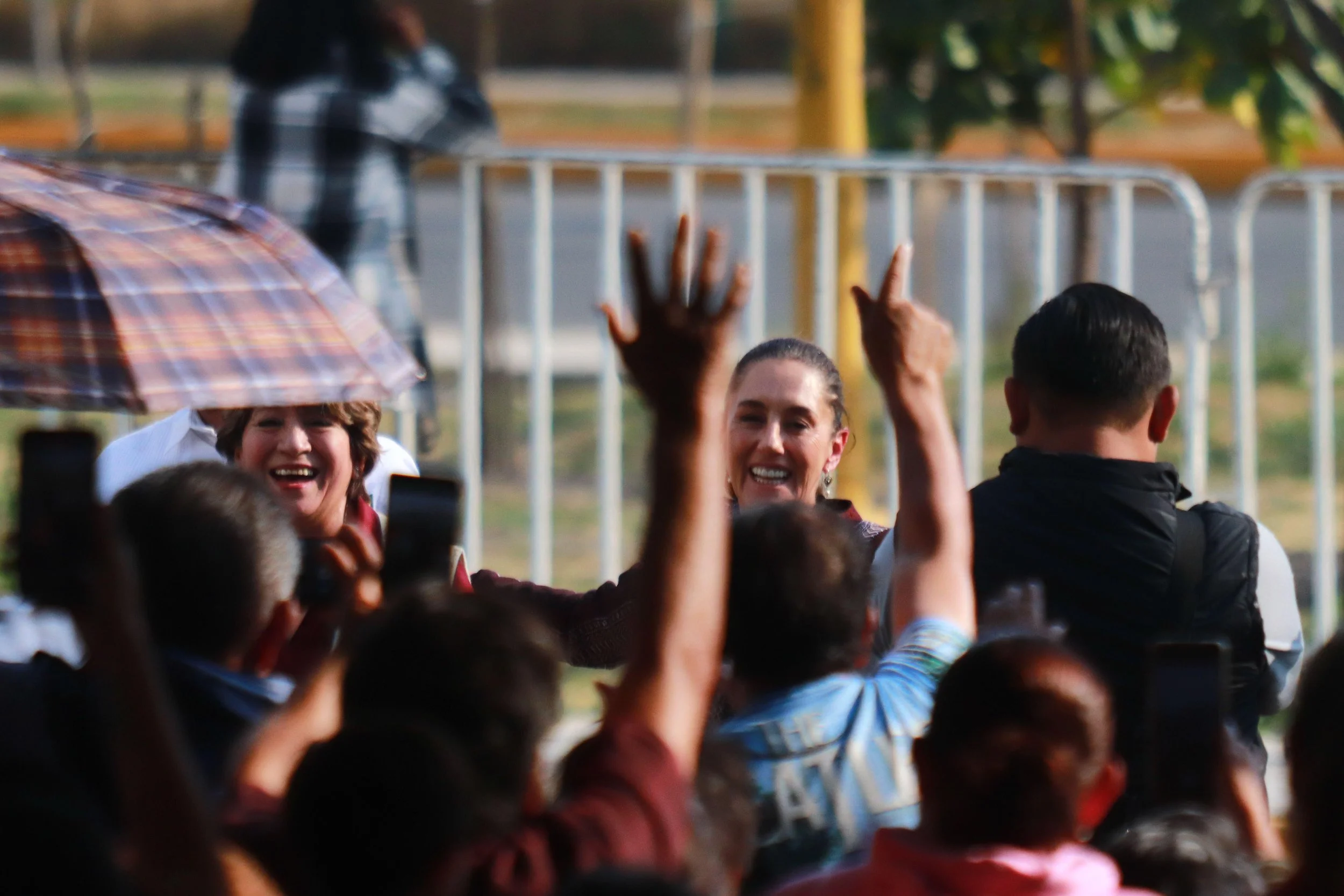
President Claudia Sheinbaum being greeted by a crowd in January 2025. Image credit: Sipa US / Alamy.
by David Agren, writer-at-large.
Andrés Manuel López Obrador swept to office in 2018 on an anti-corruption agenda. He followed the now-detested former president Enrique Peña Nieto, whose government became associated with graft. AMLO cited the annual Global Corruption Perception Index from Transparency International as proof of Mexico’s slide in decadence under his predecessors.
“According to the latest measure by Transparency International, we occupy 135th place compared to 176 countries evaluated and we moved to that place after being in 59th place in 2000, rising to 70th in 2006, climbing to 106th in 2012 and reaching the shameful position in which we find ourselves in 2017,” AMLO said in his 2018 inaugural address.
Mexico remained mired in low ratings in the TI survey through the first five years of AMLO’s administration, moving up slightly from a score of 29/100 in 2019 to 31/100 in 2023. Then it tumbled to just 26/100 in 2024, according to the latest edition of the TI survey. Mexico ranked 140 of the 180 countries measured by TI this year, lagging behind Peru, Bolivia and El Salvador, while barely beating Guatemala, Paraguay and Honduras.
The 4T – as AMLO christened his political movement – often seeks external validation such as opinion polls showing Claudia Sheinbaum and her predecessor among the world’s most popular leaders. But the current president showed predictable scorn for the latest edition of the Corruption Perceptions Index.
“Fortunately, people’s perception is different,” she said at her morning press conference. She then pointed to increased tax revenue – without raising taxes or approving a fiscal reform – as proof. “Privileges ended, corruption ended,” she added. “So obviously what there is is a change of regime, from a regime of corruption and privileges to a regime of honesty.”
It’s hard to argue with the first part of her retort: Sheinbaum won power with more than 60 per cent of the vote after running on an agenda of continuity. The annual Latinobarómetro poll of Latin American attitudes showed Mexican satisfaction with democracy hitting its highest level since the survey’s start in 1995.
AMLO spoked ad nauseam of “morals” and his own “moral authority.” Sheinbaum has branded her government with the gloss of “honesty.”
Much of AMLO’s claims seemingly came from the idea that his mere presence in the presidency would change the country. “We’re going to clean corruption out of government from top to bottom, like cleaning the stairs,” he once famously said.
AMLO’s words carried weight with the population. His narratives that money for social programs was recovered from thieving politicians stuck in the minds of recipients. He made periodic pleas of poverty, in which he showed an empty wallet and claimed not to have any assets other than a property in Chiapas.
“It gives him an aura of honesty as the man who doesn’t need anything,” Ilán Semo, historian at the Iberoamerican University in Mexico City, told the Washington Post.
A former PAN politician, who was previously on good terms with AMLO, previously described AMLO as not personally corrupt, but someone who “uses corruption” for his political purposes.
Such an example appears in AMLO welcoming politicians with checkered pasts into his movement – even members of Peña Nieto’s notorious political clan, the Grupo Atlacomulco, which was known for an ethos of mixing politics and business.
Senator Miguel Ángel Yunes Márquez, who played a decisive role in the judicial reform’s approval after allegedly being pressured with arrest warrants against family members, became head of the senate’s finance committee this week.
Former PRI governor Alejandro Murat, whose family was the subject of a New York Times investigation into foreign owners of luxury properties, recently joined MORENA. (AMLO previously called Murat running in Oaxaca proof of a “hereditary and corrupt oligarchy.”)
Corruption accusations came close to AMLO during his presidency – including accusations that a son, Gonzalo López Beltrán, “ran a network overcharging contractors supplying materials for the Tren Maya,” according to The Economist. “Another son, José Ramón, was revealed to have been living in a luxury pad in Houston connected to a contractor for Pemex, the state oil company.” AMLO and his sons have vigorously denied any wrongdoing.
Other scandals largely left AMLO unscathed, such as Segalmex – where money at the food security agency went unaccounted for. AMLO also moved to close Mexico’s transparency institute, INAI, which ultimately occurred under Sheinbaum.
But nothing stuck. So far nothing’s sticking to Sheinbaum, either.
Sheinbaum has tried pulling some of AMLO’s populist tropes. She made a plea of poverty in one of the candidate debates by claiming not to own any properties and only renting – despite a career in politics and academia. Opposition candidate Xóchitl Gálvez called Sheinbaum “bien güey” if that were actually true.
But the election showed Mexicans largely believing Sheinbaum. Gálvez, meanwhile, got hit by AMLO making unfounded corruption accusations against her business activities – part of the Mexican pattern of self-made success bringing suspicions of untoward activity.
Sheinbaum has avoided personal corruption scandals throughout her political career. She may not have the same “aura of honesty” as AMLO. But people believe her government is clean and not stealing from them – or at least it isn’t leaving them without benefits. The anti-corruption image starts at the top and it seems to be sticking.