

Many Mexicans won’t vote in Sunday’s judicial elections; will AMLO?
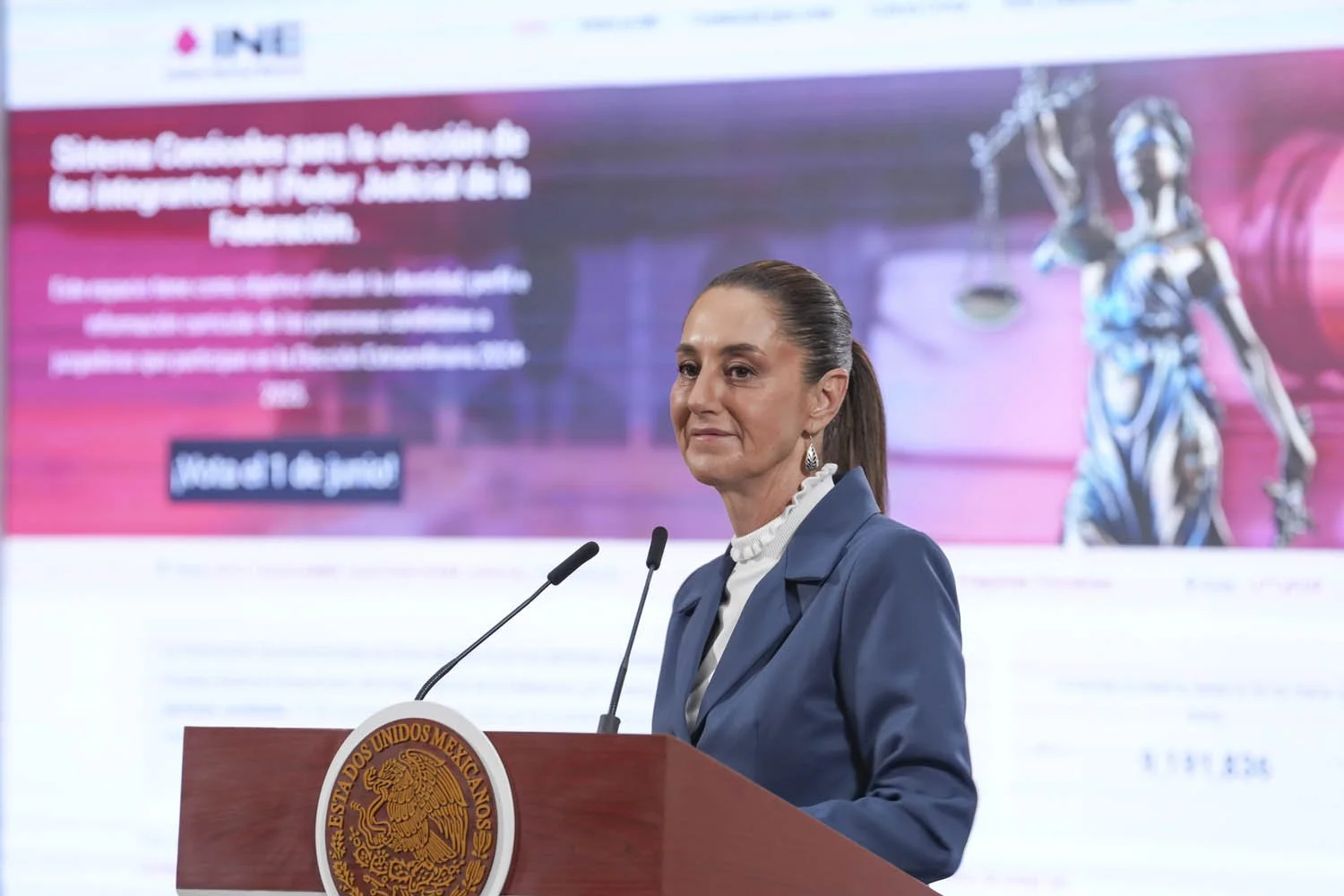
Mexico’s President Claudia Sheinbaum discussing this weekend’s judicial vote in Mexico City. Image credit: Mexican Presidency.
by David Agren.
Mexico holds judicial elections on Sunday, which will select nearly 900 judges – including supreme court justices – via popular vote. But the much anticipated elections are unfolding amid confusion, controversial candidates, and crushing disinterest – with voters paying scant attention and the ruling Morena party marshalling voters in what was supposed to be a non-partisan vote. Then there’s the opposition boycott.
President Claudia Sheinbaum targeted the opposition throughout the week leading up to the June 1 vote. She jawboned them from the bully pulpit of her morning press conference. And she employed the familiar schoolyard taunt effectively used by her predecessor and populists the world over: I know you are but what am I?
“Who is more anti-democratic: the ones calling for everyone to elect the judiciary or the ones calling for not voting? Who is more democratic?” Sheinbaum said in the Wednesday mañanera. “The argument is very convoluted, isn’t it? If the president had wanted to pick the Supreme Court’s justices, we wouldn’t have ended up as we were before. Why all the fuss?”
Taunting the opposition is a staple of the mañanera press conference. Blaming them - and presidents ruling prior to Sheinbaum and her predecessor, former president Andrés Manuel López Obrador - is the the modus operandi for their so-called “fourth transformation” (as AMLO christened his political movement). But the blame has been spread thick for this weekend’s judicial elections in the face of polls showing widespread voter apathy. Commentators have also announced their intentions of abstaining from a process they’ve criticized as a farce and a purge of the court, deriding what they see as democratic backsliding.
“You will not vote for the prostitution of democracy. You will not vote for the corruption of the vote. You will not vote for the end of justice. You will not vote for the death of the Republic,” the historian Enrique Krauze posted on X.
Polls show modest, but increasing interest in the election. A survey by the newspaper El Financiero found 47% of respondents saying they haven’t decided who they will vote for, while 23% said they weren’t interested in voting.
The same newspaper surveyed 200 judicial candidates and found 76% of them anticipating a turnout of less than 20%. That compares with a turnout of roughly 60% in the last federal election.
Headlines – at least in the foreign press – have focused on the “kafkaesque” process (to quote the FT) as voters will select judges and magistrates using lengthy ballots – picking from names they barely know anything about. (Some magistrates are running unopposed.)
Other headlines focused on the controversial candidates. Leopoldo Javier Chávez Vargas, a candidate for the federal bench in Durango, was arrested in the US for trying to smuggle nearly nine pounds of methamphetamine into the country and served nearly six years in prison, according to The New York Times.
Silvia Rocío Delgado García, who formed part of Joaquín “El Chapo” Guzmán’s legal team, was nominated by the Chihuahua state government as candidate for a state judicial position in Ciudad Juárez. At least four candidates have links to La Luz del Mundo, the politically active Jalisco church – previously PRI stallwards, but aligned now with Morena – whose leader, Naasón Joaquín García, was convicted in the US on child abuse charges.
Senate president Gerardo Fernández Noroña candidly said, “We missed some cases” in nominating subpar candidates.
Critics warned of such scenarios from the start – especially the possibility of narcos influencing the vote. They also warned of candidates effectively aligning with the ruling party – as has occurred in Bolivia, the only other country to elect supreme court justices.
Morena partisans aren’t taking any chances. The National Electoral Institute (INE) ordered a halt to the distribution of facsimiles of the accordion ballot with preferred candidates lists – actions that allegedly were being carried out by groups affiliated with Morena and the Nuevo León state government.
Commentators with 4T sympathies, meanwhile, took to shaming the opposition – or trying to blame them.
“Paradoxically, if you decide not to vote because you believe the reform is a farce, you will end up becoming its greatest accomplice,” wrote Reforma columnist Vanessa Romero Rocha, who participated in the presidency’s candidate nomination committee for the judicial election. (The legislative and judicial branches also nominated candidates).
“I feel very frustrated because I do want an independent judiciary. And I won’t have it because the people who share this desire are deciding not to vote,” commentator Viridiana Ríos said on the Televisa program, Tercer Grado.
One of AMLO’s sons, José Ramón López Beltrán, posted plenty on X about the judicial election and stated his voting intentions – endorsements in all but name. His father has said nothing about the election since leaving office Sept. 30 – nor has AMLO been seen or heard from in nearly eight months.
Sheinbaum was asked about AMLO voting in the election. But she didn’t know his plans.
“I haven't had any communication with President López Obrador,” she said. “So I couldn’t tell you whether ‘he’s going to vote’ or ‘he’s not going to vote.’”