

Can Mexico and the US understand each other?
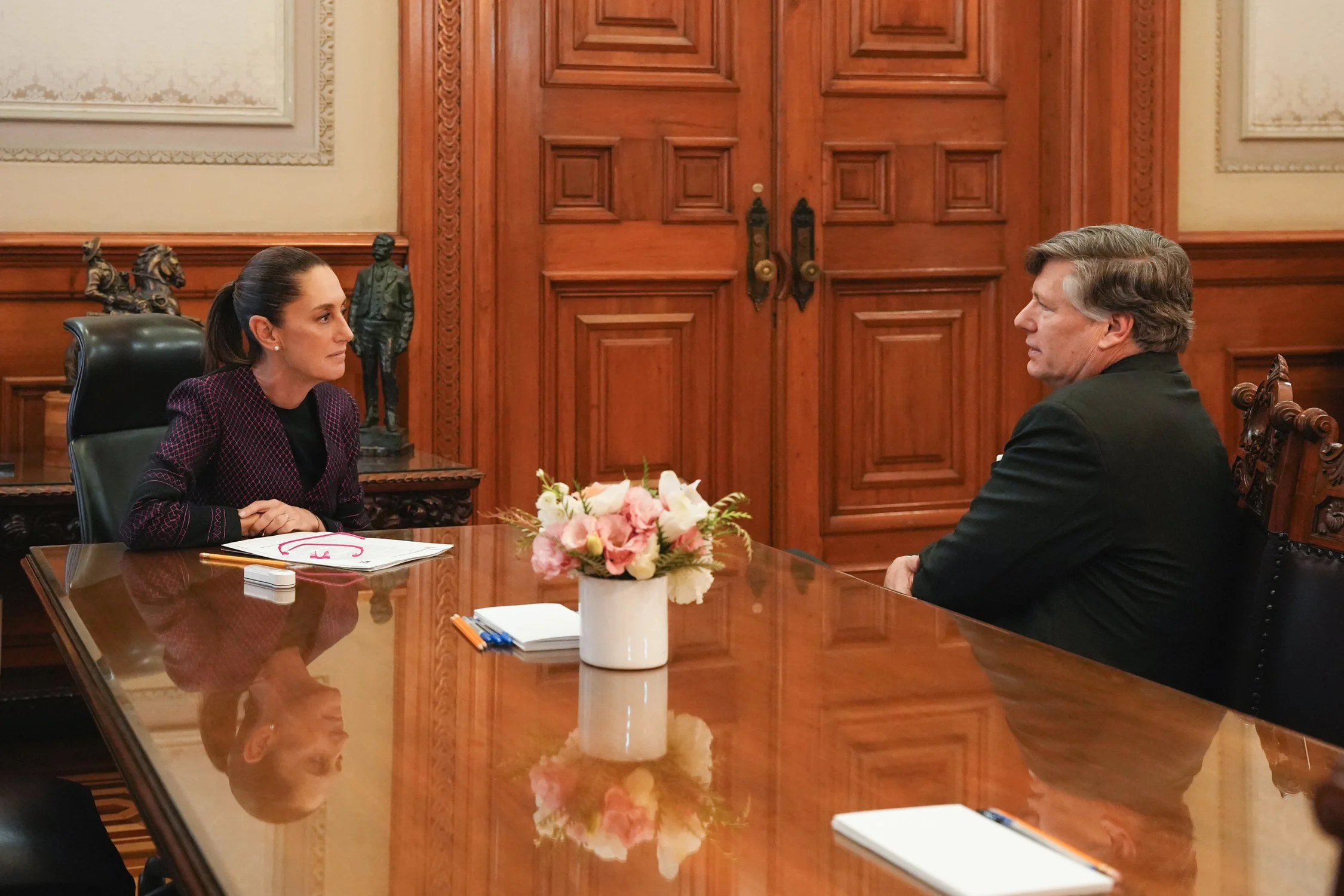
Mexican President Claudia Sheinbaum with United States Deputy Secretary of State Christopher Landau this week in Mexico City. Image credit: Presidency of Mexico.
by Luis Lozano
Editor’s note: Mr. Lozano is the former president of Toyota Motor de Mexico. A dual Mexican-Spanish national, he is now a business consultant and columnist for Mexico’s Excélsior newspaper.
Perhaps one of the more complex relationships in the world is the one between Mexico and the United States. Sure, anyone will say that relationships between neighbors are always complex. Germany, France, Spain and England spent centuries at war between themselves to maintain access to markets, geographic dominium and prevalence of their religion. But their past is common, and their populations have lived in those places for millennia.
The US and Mexico are two young countries, shaped by distinct worldviews rooted in the different empires that conquered and created them. On the US side, the prevalence of puritanism and Protestantism. Britons settled in the Northeast based the culture on collective work and humbleness. On the Mexican side (including Texas and California), no colony was created, even though Mexicans like to call it like that; the strategy of the Catholic Spanish crown was to delegate royal power to the viceroy of the territory called New Spain. The Spaniards inherited a Roman tradition of incorporating conquered populations into their culture, which is why building cities, churches, and universities was so important to them. Both of the oldest universities in the Americas were founded by Spain in what is now Lima (Perú) and Mexico City in 1551. No university was founded in North America by the English settlers at the time.
However, once both countries fought for their independence, differences started to appear which saw the US become an Empire and Mexico a nation still struggling with its profoundly different realities. One of the most important chapters in the US-Mexico relationship is how Mexico lost half of its territory to the United States. How each country has internalized this historical event perfectly reflects their distinct, idiosyncratic identities and outlooks.
When I am asked to explain the differences between Americans and Mexicans, I often use this example. If a Mexican inherits an old clock from his grandfather, he is unlikely to sell it – even if it no longer works or holds significant monetary value – because its sentimental worth outweighs its financial value. In contrast, an American inheriting the same clock might readily sell it for the right price, viewing the money as an opportunity to invest in something with greater future value.
These are two very different worldviews. For the US, Mexico is a complex and disorderly neighbor, often perceived as resentful toward Americans. The historical annexation of California, Arizona, New Mexico, Nevada, Colorado, and Texas is seen in the US as largely irrelevant because it doesn’t speak to the future. But Mexico is resentful because of the fact that it is an important chapter for its past.
Regardless of that, in 1994, the US, Canada and Mexico signed the North American Free Trade Agreement which created one of the most dynamic and competitive economic regions in the world. It has created wealth in the region and increased the economic growth of the three countries, even though politicians have used the partnership as a piñata for their own political interests. In 2018, during President Trump’s first term, the Agreement was updated. This update created more restrictions to regional free trade through increasing the North American regional value content. The idea was clever; it should have brought more investment to the three countries of North America. But lack of regional incentives, strategy and joint policy have deprived us from such opportunities.
The US and Mexico (and of course Canada) need to work together for the prosperity of North America. However, political leaders too often exploit deep-seated national sentiments, undermining the possibility of a strong and effective regional business partnership. Both countries have very different personalities, but have very complementary characteristics which have made the region – since 1994, and with very little effort – the most competitive market in the world. Imagine what we could achieve with political will.