


The politics and poetics of aguas frescas
by Ambika Subra.
At markets, fondas, and sunlit plazas, glass vitroleras cluster together, their bellies filled with horchata, jamaica, tamarindo - each sweating under the weight of the day. Inside, a long-handled ladle stirs slowly, ready to be dipped and poured into waiting plastic cups. One ladle. Many hands. These aren’t just beverages - they’re rituals of circulation: sweet, spiced, and hydrating, but also quietly collective. To drink is to join a shared rhythm. Aguas frescas carry not only flavor, but memory, labor, and the social codes of everyday life.
At this year’s TONO Festival, artist and fashion designer Bárbara Sánchez-Kane transformed this gesture into a durational performance of time, sound, and community. Founded by curator Samantha Ozer, TONO is a nomadic festival of time-based media that connects international artists with Mexico’s contemporary art scene across unconventional venues. In its third edition, Aguas Frescas unfolded over two days in the courtyard of Museo Anahuacalli, proposing a new kind of “poetry fountain” - where bodies, liquids, and instruments formed a mutable, sonic ecology. Against Diego Rivera’s basalt temple of pre-Columbian artifacts, Sánchez-Kane offered horchata as both metaphor and medium.
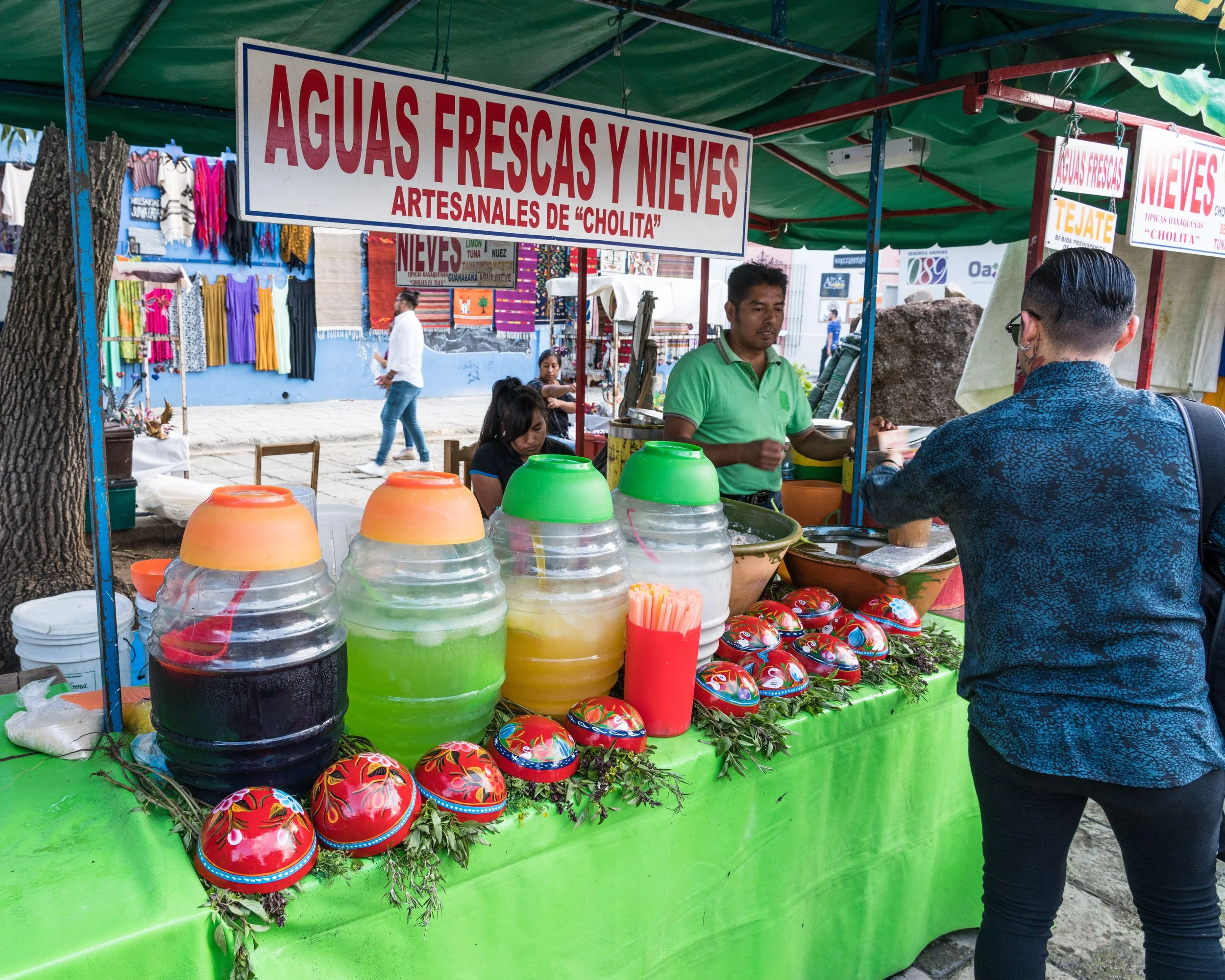
A street vendor selling aguas frescas. Image credit: Jon G. Fuller, Jr. / Alamy.
by Ambika Subra.
At markets, fondas, and sunlit plazas, glass vitroleras cluster together, their bellies filled with horchata, jamaica, tamarindo - each sweating under the weight of the day. Inside, a long-handled ladle stirs slowly, ready to be dipped and poured into waiting plastic cups. One ladle. Many hands. These aren’t just beverages - they’re rituals of circulation: sweet, spiced, and hydrating, but also quietly collective. To drink is to join a shared rhythm. Aguas frescas carry not only flavor, but memory, labor, and the social codes of everyday life.
At this year’s TONO Festival, artist and fashion designer Bárbara Sánchez-Kane transformed this gesture into a durational performance of time, sound, and community. Founded by curator Samantha Ozer, TONO is a nomadic festival of time-based media that connects international artists with Mexico’s contemporary art scene across unconventional venues. In its third edition, Aguas Frescas unfolded over two days in the courtyard of Museo Anahuacalli, proposing a new kind of “poetry fountain” - where bodies, liquids, and instruments formed a mutable, sonic ecology. Against Diego Rivera’s basalt temple of pre-Columbian artifacts, Sánchez-Kane offered horchata as both metaphor and medium.
The performance space resembled a clock. A custom off-white circular carpet marked the face, and twelve classic No. 10 chairs from Sillas Malinche stood in for numerals. Half were altered, their backrests replaced with tuned brass pipes, forming a percussive score. On six of them sat vitroleras of horchata. Inside each, a metal ladle spun, striking the pipes in a soft, liquid metronome.
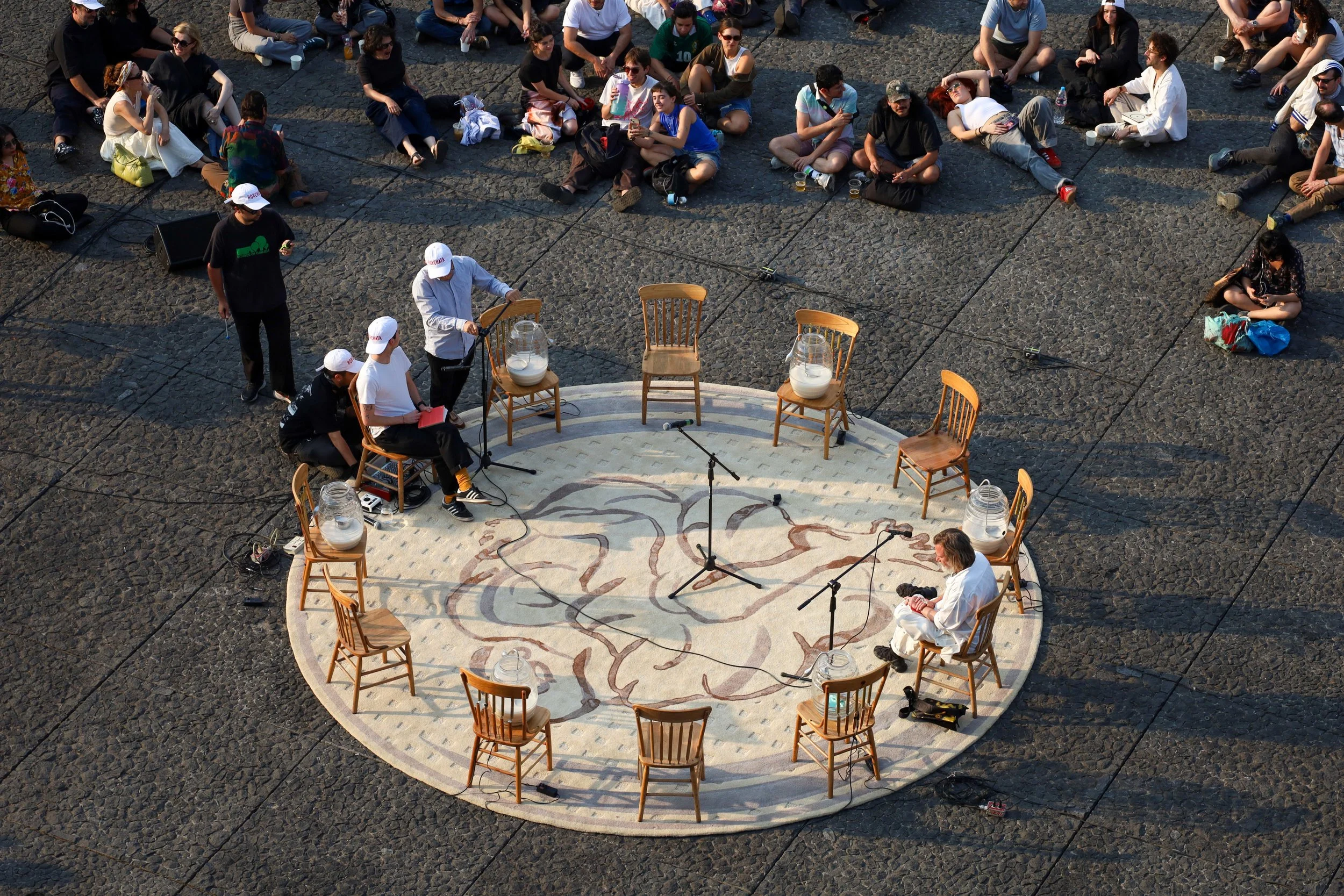
Image courtesy of Gallery Kurimanzutto and Iñaki Varela.
Like the drinks it honors, Aguas Frescas was a blend of forms - performance, poetry, choreography, installation, and sound - stirred together across two afternoons. Day one featured Ariane Pellicer, performing a monologue by Ximena Escalante, alongside poetry collective Diles que no me maten. Day two brought Luisa Almaguer, Susana Vargas, Luis Felipe Fabre, Abraham Cruzvillegas, and composer Dario AFB (Darío Acuña Fuentes-Beraín). Dario’s sprinting circuit around the vitroleras built to a sonic crescendo, a symphonic finale of musical chairs.
At the center of it all was a shared drink. The simple act of dipping from the same jar of horchata became a quiet choreography of mutuality, echoing the performance’s structure. Just as audiences drew from a common vessel, Sánchez-Kane gathered an extended circle of collaborators to build the piece together. This wasn’t authorship but co-composition - a shared table, a living archive, a sonic ecology born through relation. It pulsed with the kind of togetherness that resists spectacle: generous, open, and held.
Throughout, Aguas Frescas reframed its namesake not as a beverage, but as a liquid commons. One rooted in gendered labor, domestic ritual, and social intimacy, passed across generations and sold at the margins of formality. The piece didn’t fetishize tradition. It made it vibrate - sonically, symbolically, materially. Even the sculptural details spoke in metaphor. Bent ladles echoed Sánchez-Kane’s signature motif of splayed, stilettoed legs, gesturing to queered, feminized, and often euphemized forms of care. In fact, “aguas frescas” is slang for orgy, a nod to its sensuality, multiplicity, and fleeting, messy mix.
Co-produced with MUDAM in Luxembourg, where it will travel this fall, Aguas Frescas isn’t truly exportable. Its strength lies in its rootedness - in sound shaped by sediment, in collaborators’ breath and tempo, in the durational patience of cooled heat. At Museo Anahuacalli, Sánchez-Kane’s performance didn’t elevate agua fresca. She reminded us it already holds meaning: archive, altar, and offering - if we pay attention to how it stirs.