


Diego Vega Solorza: rewriting the language of dance
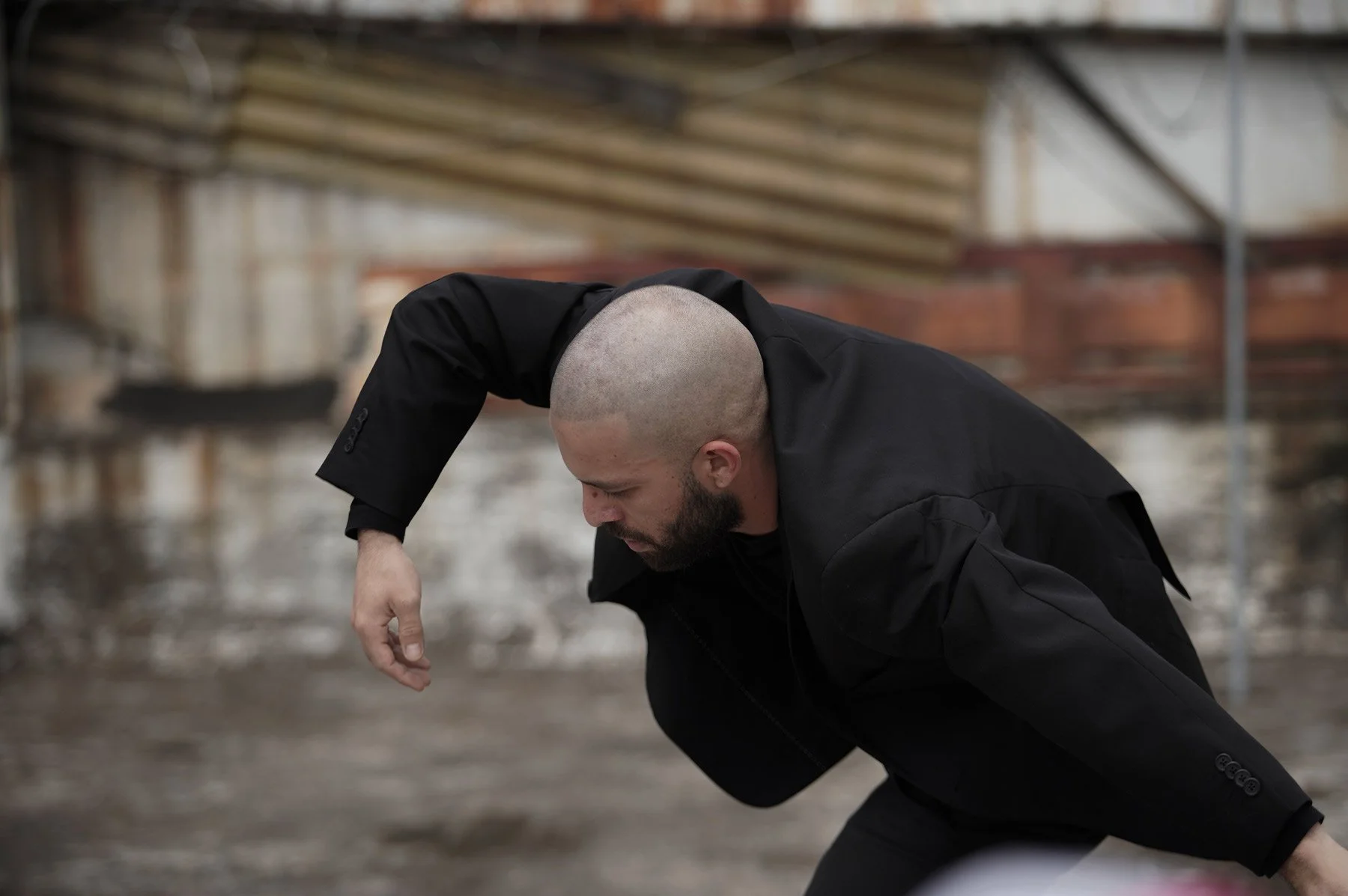
An image from Canto de Agua performance. Image credit: Don Julio and A & A Productions.
by Ambika Subra.
If you walk past a Mexico City park on a Saturday morning, you’ll likely see couples twirling to cumbia and salsa, their feet moving to rhythms passed down through generations. Movement is woven into the city’s fabric, a language of joy, spontaneity, and connection. But choreographer Diego Vega Solorza is not interested in dancing through time - he is interested in slowing it down and forcing us to sit inside its weight. His work does not unfold in bursts of rhythm but in suspension, where every gesture lingers, where movement becomes a living archive.
Vega Solorza is reshaping Mexican contemporary dance, rejecting the institutional validation that has long defined it. In a country where dance is often tied to folkloric tradition, he carves out a third space - one that refuses Eurocentric virtuosity and treats movement as a form of writing. His performances do not chase spectacle but command attention through stillness, through contrast, through the radical act of taking up time and space.
His latest work, Canto de Agua, presented at Galería LLANO in collaboration with Don Julio, embodies this philosophy. The performance is not just about water; it is a confrontation with how it is controlled, extracted, and fought over. The dancers, immersed in Rafael Durand’s live score and framed by Fernanda Caballero’s painted backdrop, move at an almost impossible pace—slow, deliberate, and fluid, as if suspended in water itself. Their movements demand patience, breaking the expectation that dance must entertain through speed. Canto de Agua transforms dance into a political act, where the body mirrors the fragility, resilience, and exploitation of natural forces.
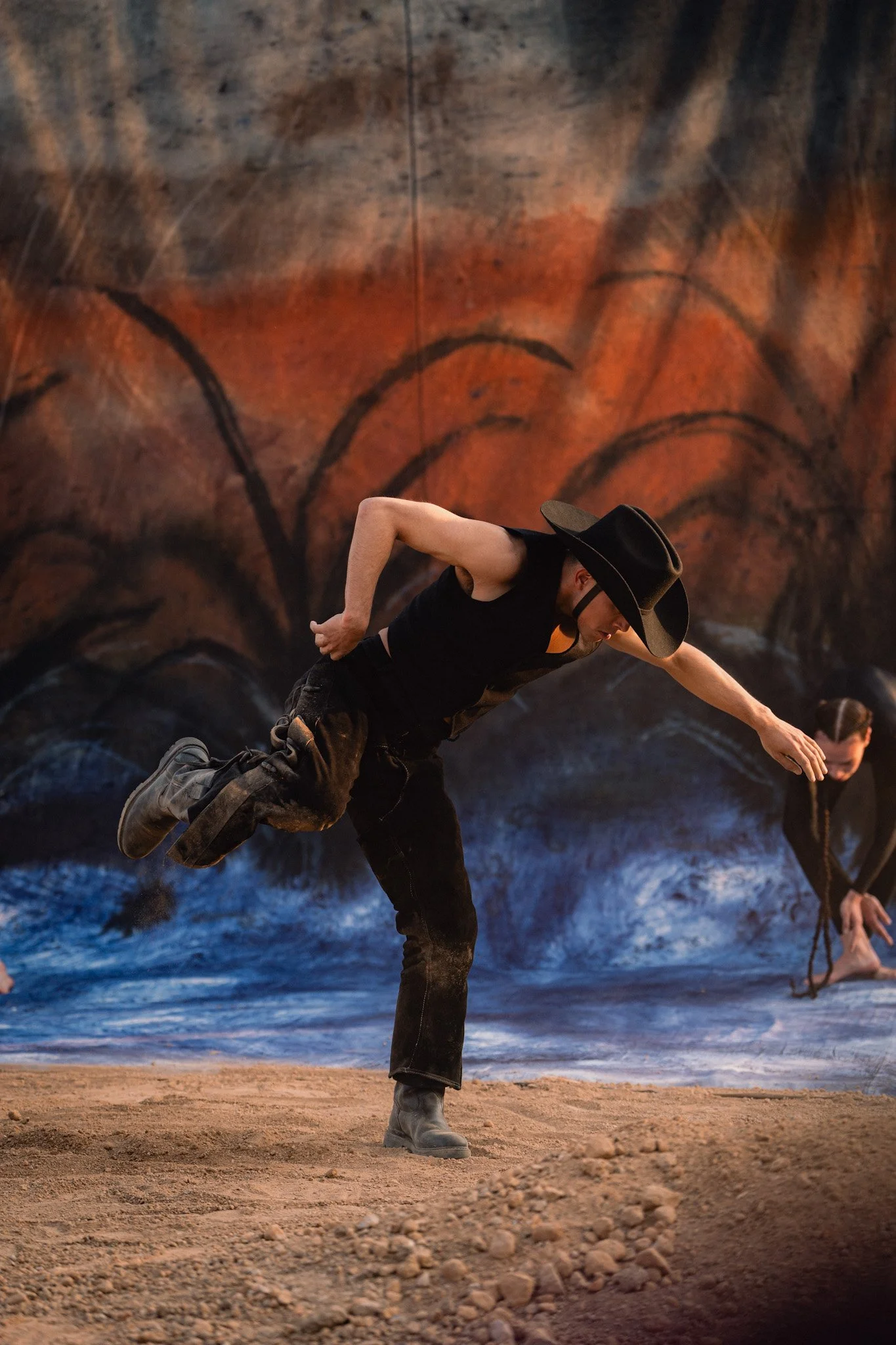
An image from Canto de Agua. Image credit: Don Julio and A & A Productions.
Vega Solorza’s work flows between the political and the spiritual. Destellos de Luz, his previous collaboration with composer Dario afb, explores this balance through two opposing dancers in dialogue. One is soft and playful, the other sharp and assertive. They do not seek to merge but witness and admire each other’s differences, creating a tension that is as intimate as it is unpredictable. When they do align, the moment is rare and electric, dissolving as quickly as it forms. Their separation is just as powerful as their unity, turning the performance into a meditation on trust, distance, and the evolution of duality in space.
Vega Solorza’s work rejects the rigid hierarchies of classical dance, choosing instead to work with performers of all body types, identities, and backgrounds. His choreography does not rely on formal technique but on how people carry weight, how they inhabit space, how they move through a world that often demands they shrink themselves. He does not see dance as something to be perfected but as something to be written, rewritten, and preserved through repetition and memory.
"Nothing in my work is accidental. There are chronometers and counts, but there is no script," he explains.
Vega Solorza is building a new framework for contemporary dance, one that thrives outside the canon in Mexico City’s independent art and performance scenes. By expanding dance into visual art, music, and radical social and spiritual critique, Vega Solorza is not just shifting how dance is performed - he is reshaping how we experience time, movement, and human connection. His work demands patience. It demands attention. And in a world that is constantly moving faster, it reminds us of the power in slowing down, in witnessing, in waiting.

What lies beneath: the living archives of Lorena Mal
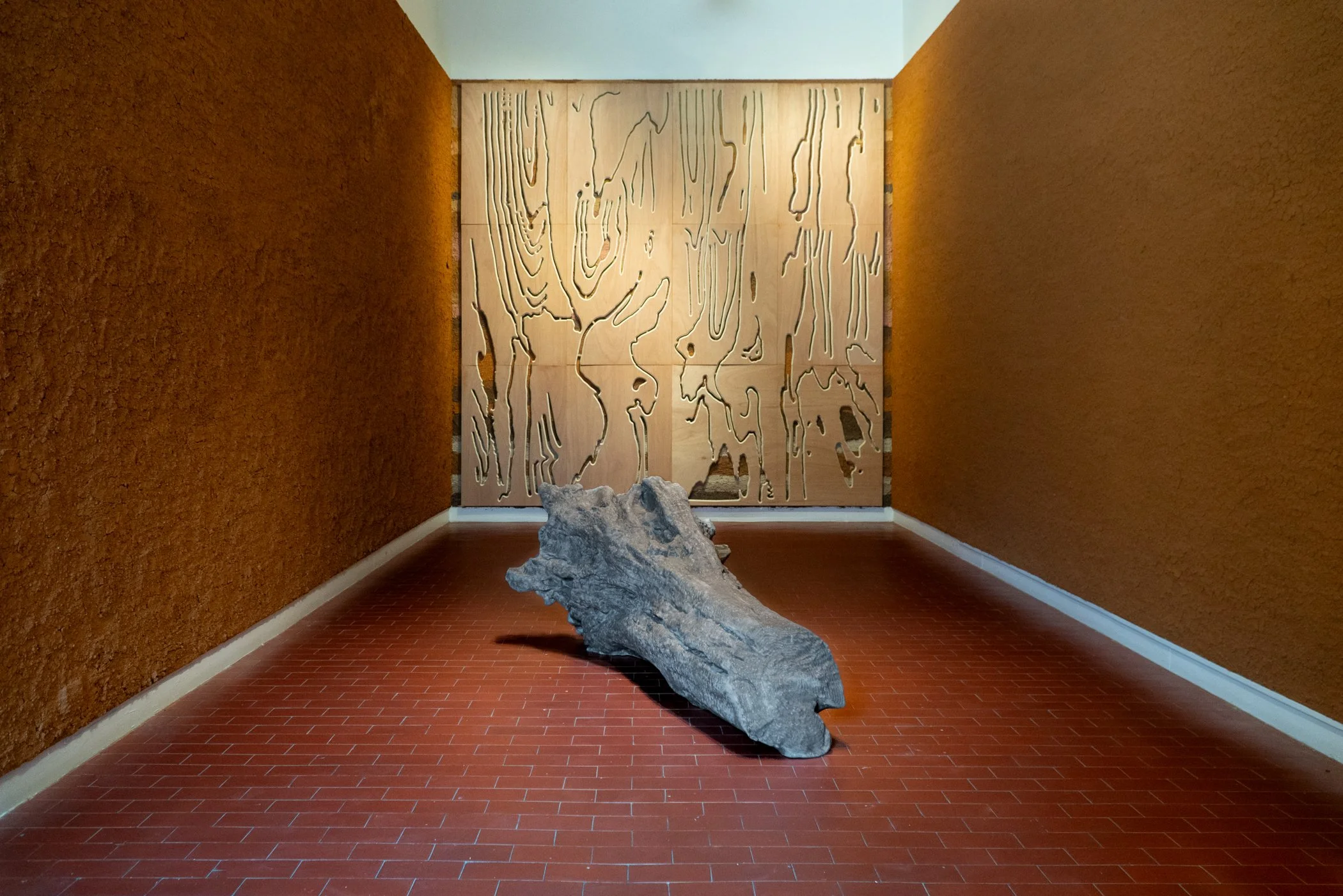
Lorena Mal at the 15th Bienal FEMSA: La voz de la montaña [The voice of the Mountain], 2024. Museo Regional de Guanajuato Alhóndiga de Granaditas (INAH), Guanajuato. Courtesy of Bienal FEMSA. Photograph: Ramiro Chaves.
by Ambika Subra.
Unearthing the hidden narratives beneath our feet, Mexican artist Lorena Mal is revealing the deep entanglements between land and power. She is an excavator—not only of the earth’s soil and trees, but of the knowledge systems, political structures, and forgotten narratives embedded within it. Working across sculpture, performance, and archival intervention, Mal dismantles the illusion of landscape as a neutral backdrop. Instead, she exposes it as a charged site of conflict, migration, and resilience, shaped by forces both geological and geopolitical. One of the most exciting voices in contemporary Mexican art, her recent works at the XV Bienal FEMSA and Museo Jumex have cemented her place as a radical force in rethinking our experiences of landscape.

(Detail) Lorena Mal, Restregarnos tierra en los ojos [Rubbing dirt in our eyes], 2024. Santa Rosa soil from Guanajuato (MX), site intervention, 89m2.
Mal refuses to see land as separate from history. In Restregarnos Tierra en los Ojos, an installation commissioned for the XV Bienal FEMSA, she created an archive of occupation and displacement by covering the space’s surfaces with soil—a raw, living material applied in a fermented state, allowing microbial life and air to bind it into a clay that naturally cracked and shifted over the four months of the exhibition. Sourced from the Bajío, the soil bore the region’s long past of floods and droughts, colonial mining extraction, and environmental destruction. Who has the right to a land? Who determines its fate? Mal’s intervention blurred the lines between architecture and archaeology, embedding the region’s instability directly into the walls of the exhibition. The soil itself became testimony—not just a metaphor, but an active record of conflict, survival, and resistance.
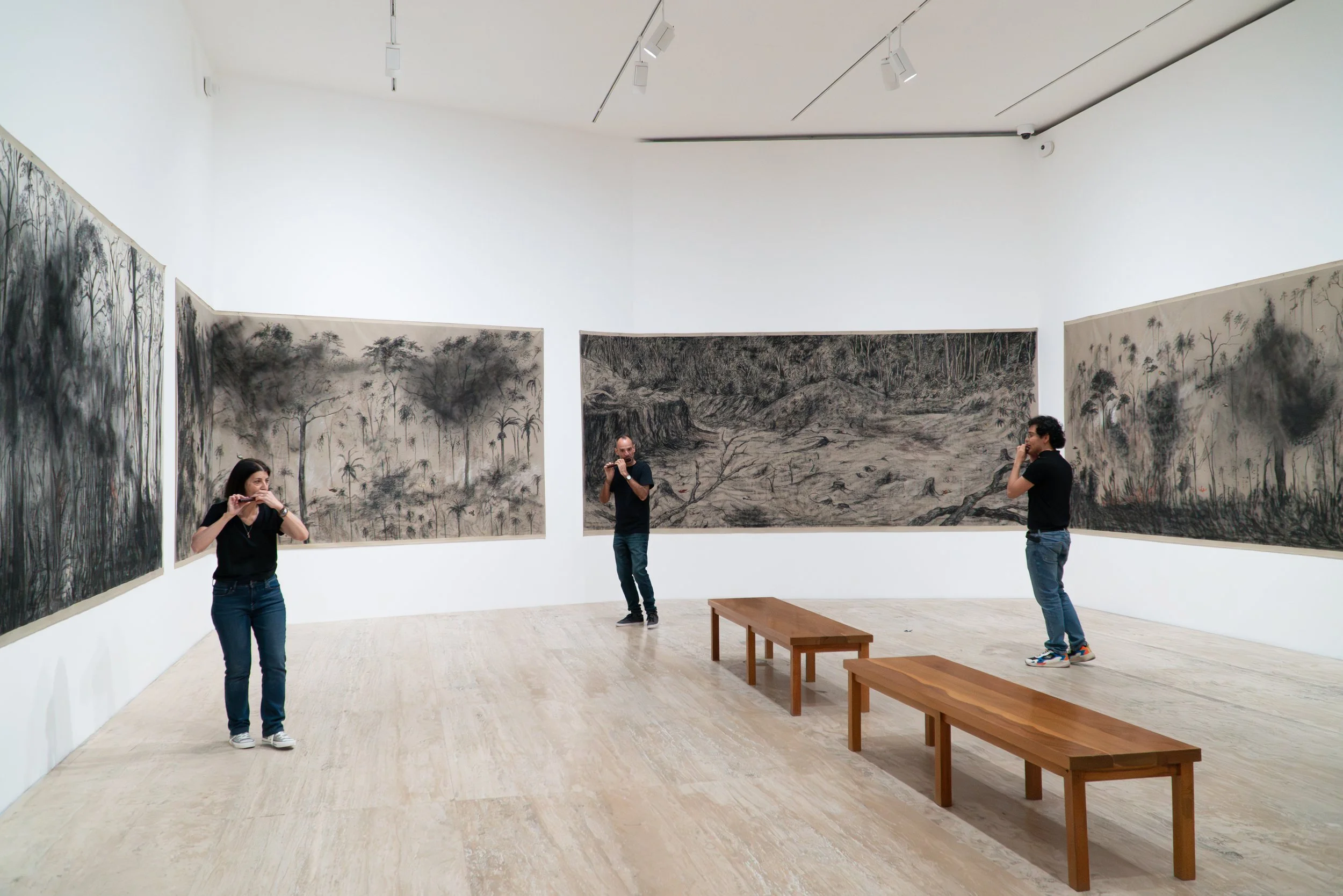
Lorena Mal, Largo Aliento. Dejarse mover por el viento [Long Breath. To be moved by the wind], 2024. Performance for 3 interpreters and 3 woodwind instruments built by the artist, variable dimensions / years. Documentation of the performance at the “Siluetas sobre maleza” exhibition at the Museo Jumex, Mexico City, 2024. Courtesy of the artist.
Beyond the visible, Mal’s work listens. In Largo Aliento, performed at Museo Jumex this past year, she translated tree rings into sonic compositions, using instruments made from those trees as a vehicle for a deep, resonant breath. Just as the soil preserves and reveals the memory of land through its raw materiality, Largo Aliento treats breath as a conduit for memory, where tree rings vocalize their silent histories. These rings, like layers of sediment, hold the imprints of environmental upheavals—fires, droughts, cycles of violence and renewal. By playing their breath, Mal does not impose a structure onto their histories but coaxes out their latent recollections, turning them into sound. Her instruments do not adhere to tempered scales or fixed notation, but instead respond to human interaction. This relationship resists linear time in favor of something more fluid and horizontal, creating a resonance that blurs the boundary between past and present. Both earth and breath become modes of listening—fragile yet persistent archives of what landscapes remember.
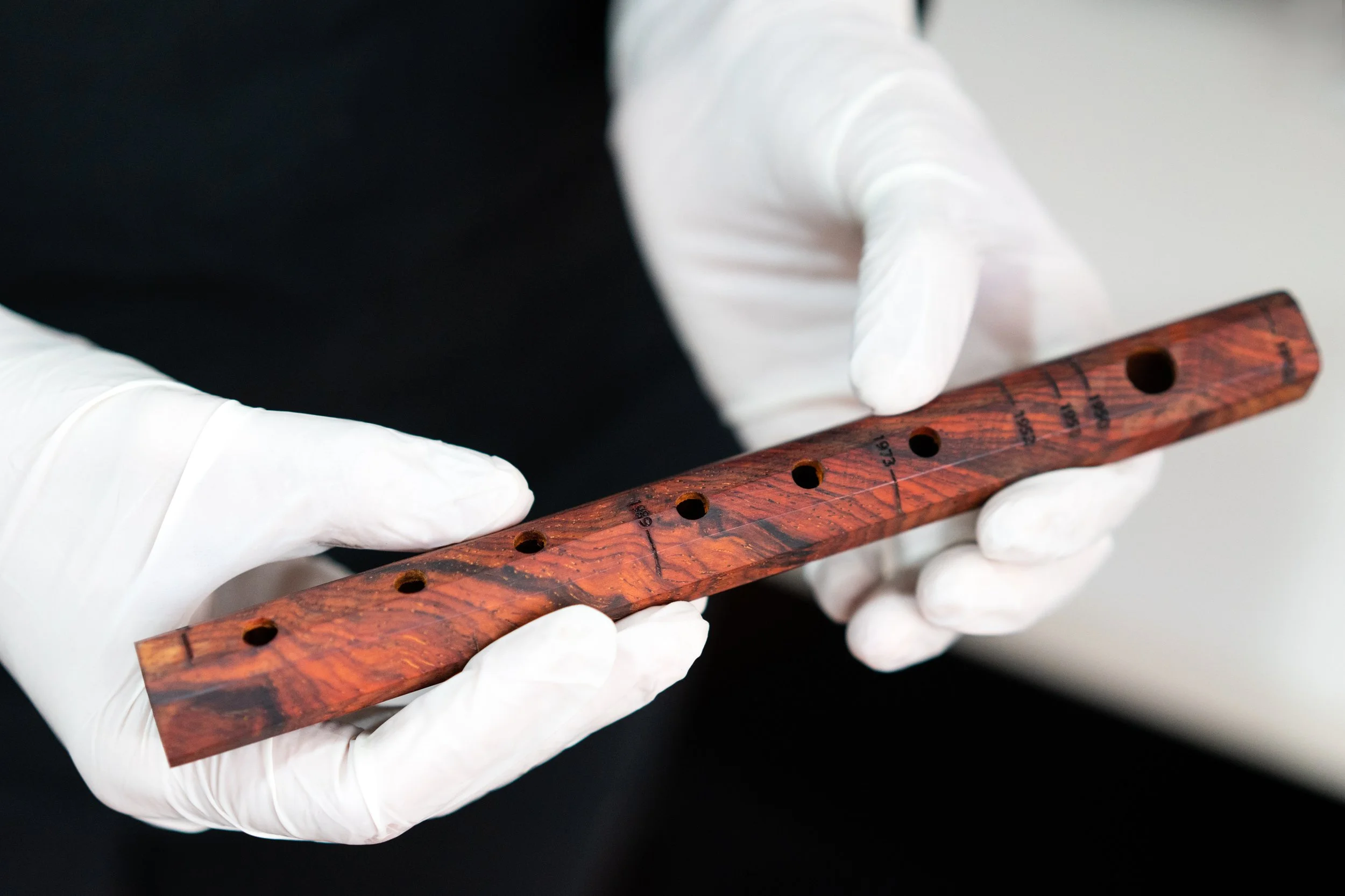
Lorena Mal, Largo Aliento [Long Breath], 2019. Woodwind instrument built by the artist with dalbergia wood that makes visible the hundreds of years lived by the tree from which it is made, indicating the dates in which they lived analyzed by dendrochronology, 19.5cm / 76 years. Courtesy of the artist.
History is not confined to human narratives alone. At its core, Lorena Mal’s work is about destabilization—of narrative, of power, of our very understanding of place. She is not interested in transformation as a fixed act but in how landscape holds and reveals its own records through its raw architecture. Mal excavates how land bears witness to colonial displacements, migrations both human and botanical, and the erasure embedded in plantation histories. By blending materials across geographies, carving new sonic pathways through time, and forcing us to confront what lies beneath our feet, Mal reframes the land as an active force—one that remembers, resists, and refuses erasure. Her practice is not simply an exploration of landscape; it is a reconfiguration of how we engage with the world itself.